Category Archives: Electoral Systems

Egyptian SCAF unveils new electoral system

Egyptian Army council General Mamdouh Shahin announced on Wednesday final amendments to the country’s electoral law. The new system has a lot in common with what I previously wrote about, with some key changes. Under the new system, fifty percent of seats in the lower house of parliament, the People’s Assembly, will be awarded through closed-list proportional representation, while the other half will be awarded in two-seat districts.  This is a change from the draft law the SCAF put out where only one third of seats would be PR.  Perhaps the most interesting aspect is the extremely low threshold for entering parliament, which was placed at 1/2 of all national votes.

The new law also abolishes the 64 seats reserved for women, which was instituted before the last election in 2010. In its place is a provision that mandates every party list must include at least one female. Other changes in the law include lowering the age for candidate eligibility from 30 to 25, and stipulating that elections take place in three stages.

I can think of three major implications of the new laws.  Let’s start with the new PR tier.  The ordinal tier of seats will be divided into 58 constituencies, which for 252 seats (half of the 504 elected members) will create an average district magnitude of 4.3  That’s not very proportional; combined with the two seat districts this system still looks very majoritarian.   This makes the .5% threshold all the more bizarre.  As far as I know this would make Egypt’s threshold the lowest in the world, even more so than neighboring Israel.  While Israel’s one nationwide district allows for extreme party fragmentation, however, I don’t think Egypt’s threshold will have much impact.  Maybe Egypt’s planners read Carey and Hix’s recent paper, The Electoral Sweet Spot: Low-Magnitude Proportional Electoral Systems.  In the paper, the authors,  find an optimal district magnitude – around three to eight seats – which produces low party fragmentation while still retaining a level of proportionality associated with higher seats per district.  This sort of assumes, however, that the other half of seats aren’t awarded in the strange two-seat districts that Egypt’s will be.

The second, somewhat related point, is the impact this system will have on women’s representation.  Mandating one candidate per list be female is a weak stipulation.  With no requirement for where on the list the women has to be, it will be easy for a party to bury women at the bottom of their lists.  This incentive will only increase in small magnitude districts as it will become more likely that only the top one or two candidates will be elected.

As far as the three stages for elections go, I think this is also a bad idea.  The fear I have with this is it will give parties an incentive to call for a boycott after the first stage if they don’t like the results.  This could have the effect of delegitimizing an otherwise well-conducted election.  (I’m not assuming it will be of course).

Fidesz introduces draft law for new electoral system

Fidesz - Hungarian Civic Union

Hungary’s governing party, the right-wing Fidesz,  proposed a plan this week to alter their country’s electoral system. Fidesz’s draft law would end the second round of voting in the National Assembly, cut the number of lawmakers from 386 to about 200, and abolish the system of compensation seats. Currently, Hungary has a unique system where compensatory seats are allocated to parties for non-winning candidates and party lists. The draft law would also allow Hungarians living abroad to vote, and guarantee ethnic minorities without representation a non-voting member in the National Assembly.

This is a pretty disturbing development although not shocking given the governing style of Fidesz since they’ve taken power.  Opposition parties argue that the proposed changes would benefit Fidesz, while hurting smaller parties, which is competely true. Unfortunately, there is not much anybody can do about it as Fidesz captured two-third of seats in the last election, which is enough to change the constitution unilaterally.  Two-thirds is a lot, but it hides the fact that the party only managed 53 percent of the popular vote.   Hungary’s system is parallel, not proportional, so its ordinal tier doesn’t really address any discrepancies that may arise from the nominal one.  Abolishing the second round for district-based seats, and removing the compensatory seats, however, is a big deal.   Everyone who looks at the 2010 election results agree that Fidesz would have performed even better if the proposed rules were in place.

I’m  a bit puzzled by the move to abolish the system of compensatory seats, which was useful for ensuring some ethnic minority representation.  I was always under the impression that Hungary was keen to provide minority representation because there were so many ethnic Hungarians living as minorities in neighboring countries.  I don’t know what the optimal way to ensure minority representation is but non-voting members doesn’t really seem to cut it. I know here in D.C., Eleanor Holmes Norton doesn’t feel she has much clout, and I imagine it is the same everywhere.  I would be curious to know though: are floor debates important in any legislative chamber any more?

The Implications of Egypt’s Proposed Electoral System (Long)

Ukraine moving forward with changes to electoral system

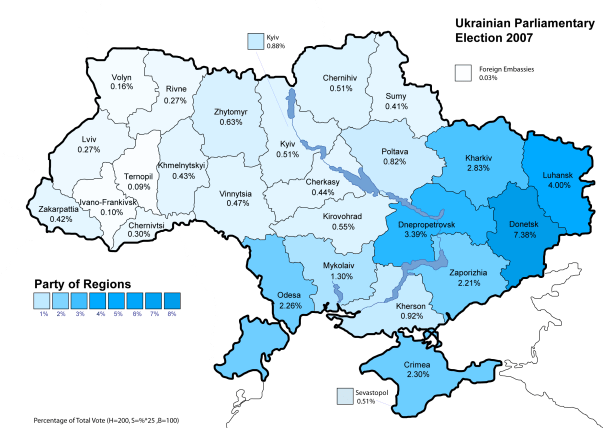
Party of Regions' performance in 2007. It's really only the Party of certain Regions (Photo property of DemocracyATwork).

Ukrainian President Viktor Yanukovych is forwarding the new draft law on elections to the Venice Commission, the next step in formally changing the country’s electoral system. Ukraine currently uses a closed list PR system, and the proposed reforms will add a tier of single member district seats. This will essentially revert Ukraine to a parallel system, which it had before the Orange Revolution in 2005.  Among the other proposed chanegs include:

  • Increasing the threshold from three percent to five;
  • Banning “Blocs,” defined as a group of politicians who share the same or nearly the same political goals;
  • Eliminating the option on ballots to “not endorse any candidate.”

The elimination of Blocs is a clear move to hurt Yulia Tymoshenko’s coalition (BYuT) although the official argument is that they produce unstable governments.  Reinstating the nominal tier is, likewise, considered an advantage for Yanukovych’s Party of Regions (PoR).  None of these are bad changes per se, but given the context, it has caused critics to cry fowl.   Yanukovych did manage to push through similar reforms at the local level last year so it is unlikely he will be unsuccessful this time around.

The importance of individuals in open list PR. Ctd.

Over at Fruits and Votes, MSS addresses my post on Hong Kong’s new method of filling vacant seats through OLPR.  He adds:

A potential benefit of the proposal, however, is that it should reduce the incentive of parties to rotate some of their legislators between elections. Doing so is common in OLPR systems–elsewhere (I do not know about Hong Kong)–and undermines the connection of elected legislators to the electorate. Under the Hong Kong proposal, a party would often forfeit the seat if it sought to swap out a member.

I was unaware of this phenomenon, but that makes sense.  I think this point really illustrates how unique this method is.  I typically associate PR parliamentary systems as being ones where the party owns the seat, not the individual.  As seat allocation is first determined by a party’s share of the vote, this is still somewhat true.  The new rule, however, would give an individual MP far greater ownership over their seat. MSS continues:

As for the Carey-Shugart (1995, Electoral Studies) we only claim that low-M OLPR places less premium on cultivating a personal reputation than does higher-M OLPR. The story is seen from the competing candidates’ point of view. From the voters’ point of view, however, smaller magnitudes and shorter lists undoubtedly increase the visibility of those who are elected, who win with greater shares of their party’s votes. I actually think this method for filling vacancies makes more sense for smaller district magnitudes than it would for larger. Whether it makes more sense than the usual party-centric way is an open question, and one that might not have a clear answer.

Egypt’s proposed electoral system

I’m about a week late to this but Egypt’s transitional military government has released a draft law of the country’s new electoral system.  The draft is somewhat short on details, such as minimum thresholds, but the basic thrust is that 1/3 of seats would be allocated through closed-list PR and the rest would use the individual candidacy system that is currently in place.  This means that each district has two candidates and each elector gets two votes.  If no candidate receives an absolute majority in the first round, a second round is held one week later.

Photo property of David Jandura

A rough translation of this from the draft law:

The individual candidate shall be elected by the absolute majority of valid votes cast in the election. If the two candidates who gained the absolute majority were not workers and peasants, the one with the largest number of votes shall be declared elected, and a re-election in the constituency shall be conducted between the candidates from workers and peasants who obtained the largest number of votes. In this case, the one with the largest number of votes shall be declared elected.

If there was no absolute majority for one of the candidates in the constituency, a re-election shall be conducted among the four candidates who obtained the largest number of votes, provided at least half of them are workers and peasants. In this case, the two candidates who got the highest number of votes shall be declared elected.

I will have more to say on this, but my main point is the individual tier, as it exists, is highly candidate-centric and will greatly weaken political parties.  In particular, the two-round, two-seat system creates an incentive for local elites to make grand bargains that further undermine an already weak party system.  Two elites, for example, can make a bargain where they tell their supporters to cast their two votes for each of them – a de facto joint ticket.   Those same elites could then make separate deals with weaker candidates.  This would entail a  promise to support the weaker candidate in the second round (should they make it) in exchange for first-round support for themselves.

The nascent party system in Egypt is very weak.  A recent IRI poll shows that of all existing parties, Al Wafd garners the most support with a paltry six percent.   Parties as institutions also suffer from worse approval ratings than state-owned media and the hated business community.  Creating even a small PR tier is a welcome move but I certainly hope the final law will make it much larger than 1/3 of all seats.

The importance of individuals in open list PR

Hong Kong's Legislative Council Building. Photo property of Baycrest

The Hong Kong government recently announced a proposal to change the way they fill vacant seats in the Legislative Council.   Hong Kong elects its MPs through open list proportional representation; the current method of filling a vacant seat is through a special election.  While this seems somewhat intuitive, a special election is actually inconsistent with the values of a PR system.  Awarding seats proportionally only really works if you have multiple seats up for grabs at once; otherwise, it just becomes a standard SMD race where the two largest parties will dominate. Most countries fill empty seats by picking the next in line candidate on the previous office holder’s party list.  The new Hong Kong proposal, however, is to replace the vacant seat with the first unelected candidate on the party list that had highest number of remainder votes in the previous election.  What does this mean?  Proportional representation systems rely on quotas to evenly allocate seats to each party. This works by using as system where each seat in a legislature corresponds to a raw number of votes, equal to a quota.  A party’s total seat total then, depends on the number of quotas it wins in an election. Although there are various ways to allocate seats (largest remainder or highest average method) no PR system can perfectly award seats in one-to-one relation to vote shares as leftover votes are bound to exist. Giving the seat to the first candidate on the list with the largest remainder then, is essentially giving it to the first candidate who did not win a seat in the last election.

A Government spokesman said, “A vacancy arising mid-term in the geographical constituencies (GCs) or the newly established District Council (second) functional constituency (DC (second) FC) seats will be filled by reference to the election result of the preceding general election.  The first candidate who has not yet been elected in the list with the largest number of remainder votes in the preceding general election will be returned.  These constituencies adopt the proportional representation list voting system.  The proposed replacement mechanism is consistent with the proportional representation electoral system and reflects the overall will of the electors expressed through the general election.”

This is interesting because it assumes that individual candidates are driving vote choice more than party label.  There are five constituencies in Hong Kong for thirty seats, so the average district magnitude any party list competes on is around five or six.  I’m guessing this small district magnitude is what’s leading them to conclude that personalities matter.   Hong Kong uses the Hare quota to allocate seats, the simplest method of seat allocation and one that generally favors smaller parties.  As Hong Kong seems to return several small parties to parliament with one seat each, maybe they assume that the individual candidate who captured that seat was a big reason for the party’s success. To me this is contrary to what the literature would suggest.  According to Carey and Shugart, low district magnitude in open list PR decreases the incentive for a candidate to cultivate a personal vote.  In contrast, it is in high magnitude, open list PR where candidate preference matters more.  This is because in a larger list, candidates have a stronger incentive to distinguish themselves from their fellow list members. Ultimately, we don’t really know why any individual is voting the way they are, but I think the Hong Kong government’s assumption requires more explanation.

Egypt reveals new electoral law, stalls on system design

The New Wafd Party

Egypt’s military government announced amendments to the electoral law today, although noticeably absent was any mention of the country’s electoral system. From what I gather the debate is currently between list pr and single member districts although the details of either have been nonexistent.

While it’s nice they aren’t rushing such an important decision I do think they need hurry up if they want to hold the September elections on time.   District creation takes time, at least if you want to do it fairly.   Furthermore, this is creating an unfair burden on political parties who have no way of devising electoral strategies.  If a nationwide, list pr system is adopted this is not nearly as big a deal, but that is unlikely.  Any sort of district creation, however, will force parties to prioritize where they run candidates.

All electoral systems force tactical voting, but Egypt’s fractionlized party system will place an extraordinary burden on voters.  In order to cast a tactical vote, a citizen must know the relative strength of each party.  This allows an individual to avoid wasting a vote on a party that has no chance of winning, while picking the best option that has a realistic shot at victory.  In Egypt, the electoral viability of any given party or candidate in a district will be largely unknown, and the longer it takes to draw district, the less time elites will have in providing that information to voters .

Formal models that predict the effective number of parties, optimal organization strategies for parties, and tactical voting decisions by electors, are all based on the assumption that actors have an understanding of the parties’ strength.  I believe this lack of information will disproportionality hurt secular and liberal parties, while favoring the more organized Muslim Brotherhood.  The reason for this?  The Brotherhood occupies a space on the right of the political spectrum larger than any liberal party occupies on the  left. Tactical voting, in other words, will be a much greater challenge for these voters. Or to use a Downsean model, the cost of obtaining information for a conservative is far less than that for liberals.  It may be the case that Egypt’s military rulers are putting of the decision on an electoral system in an effort to make the election fair.  The longer it takes for them to decide, however, the less legitimate the results will be.

Egypt to abandon current electoral system

It looks like Egypt will be scrapping its current electoral system in favor of some sort of mixed or parallel system.  I’ll have more to say on this soon, but the short takeaway is this is terrific news for secular and liberal parties.   Egypt’s current system creates several coordination problems and favors local elite powerbrokers over actual parties.

Vote choice and referendums

Apparently they didn't

Via Matthew Shugart comes this discussion at the LSE blog about public opinion and electoral system reform in the United Kingdom.

One of the takeaway points for me is that voters have consistently voiced strong support for systems that are more proportional, but that support quickly evaporates once it is described to them what a proportional representation system is. This isn’t that surprising; traditional tradeoffs between fair and effective governance, although overstated, are easier to make when they are abstract.  When you start to think about how they will impact your preferred party, however, things might be different.

This made me curious to see if there has been anything written about vote choice and direct democracy, with a particular interest in the impact of elite signaling.   The best thing I found was this paper by Simon Hug and Pascal Sciarini, which discuss how different variables about a referendum affect vote choice. Examining data from fourteen European integration referendums, Hug and Sciarini essentially claim that issue saliency determines voting behavior.  In important “first-tier” elections, voters make a decision by weighing the actual issue.  On less important “second-tier” elections, voters may base their decision on their assessment of the ruling party.  This comes in the form of voting against the wishes of the government if one is dissatisfied, and voting in favor if one is supportive. This makes sense but it only explains voting behavior using a rational choice/retrospective model, where voters retroactively form their opinions of parties after evaluating their performance in office.

I’m not against looking at things this way, but I don’t think it’s appropriate for every type of referendum.  The UK AV referendum, in particular, doesn’t fit any existing model.  I’m not sure if the election would count as “first or second tier” in importance – the 40 percent turnout leads me to believe second –  but I don’t  think it matters. Even if it was first tier, voters would not be able to punish the ruling government as it was made up of a coalition divided on the issue.  To me, it’s very difficult for a voter to not weigh the issue through a partisan filter because the referendum is essentially a vote on future partisan performance. Yet, as we’ve previously discussed here, there still seemed – at least according to one earlier survey – that a decent amount of partisans were going against their party.  I would like to see more written about this by people who know more and have more data to play with.  I’m guessing that committed Tory and LibDem partisans took cues from their party leaders.  Labour partisans, having been sent such mixed signals from thier elites, would be interesting to examine.  Did Labour voters have a clear idea over whether AV would help or hurt them?  I think you could make arguments either way but I’m not sure what they heard. Also, how did those with weak identification vote, if they even turned out?