Author Archives: JD
Egypt’s proposed electoral system
I’m about a week late to this but Egypt’s transitional military government has released a draft law of the country’s new electoral system. The draft is somewhat short on details, such as minimum thresholds, but the basic thrust is that 1/3 of seats would be allocated through closed-list PR and the rest would use the individual candidacy system that is currently in place. This means that each district has two candidates and each elector gets two votes. If no candidate receives an absolute majority in the first round, a second round is held one week later.

Photo property of David Jandura
A rough translation of this from the draft law:
The individual candidate shall be elected by the absolute majority of valid votes cast in the election. If the two candidates who gained the absolute majority were not workers and peasants, the one with the largest number of votes shall be declared elected, and a re-election in the constituency shall be conducted between the candidates from workers and peasants who obtained the largest number of votes. In this case, the one with the largest number of votes shall be declared elected.
If there was no absolute majority for one of the candidates in the constituency, a re-election shall be conducted among the four candidates who obtained the largest number of votes, provided at least half of them are workers and peasants. In this case, the two candidates who got the highest number of votes shall be declared elected.
I will have more to say on this, but my main point is the individual tier, as it exists, is highly candidate-centric and will greatly weaken political parties. In particular, the two-round, two-seat system creates an incentive for local elites to make grand bargains that further undermine an already weak party system. Two elites, for example, can make a bargain where they tell their supporters to cast their two votes for each of them – a de facto joint ticket. Those same elites could then make separate deals with weaker candidates. This would entail a promise to support the weaker candidate in the second round (should they make it) in exchange for first-round support for themselves.
The nascent party system in Egypt is very weak. A recent IRI poll shows that of all existing parties, Al Wafd garners the most support with a paltry six percent. Parties as institutions also suffer from worse approval ratings than state-owned media and the hated business community. Creating even a small PR tier is a welcome move but I certainly hope the final law will make it much larger than 1/3 of all seats.
Visualizing empires decline
I don’t have much to say about this, but I really enjoyed this visual presentation of the European empires. I’m not sure how the creator of the video is determining the size of each bubble (GDP?) but I think it’s at least a neat idea for a way to visualize the relative strength of each respective country. Data visualization is important and this to me does a good job of presenting data in a way that’s easy to observe.
Malta legalizes divorce
Citizens of Malta on Saturday voted in a referendum on whether or not to legalize divorce. The heavily Catholic Malta is currently the only European country where divorce is still banned, and apparently one of the last in the world. Official results show that 53 percent of the Mediterranean island’s voters were in favor of the measure, which asked whether parliament should pass a law allowing couples to divorce after four years of separation. The referendum was non-binding; parliament is still required to pass a new law, but the prime minister has indicated he will respect the wishes of the people despite his personal opposition. One of my favorite arguments by the anti-legalization side was that legalizing divorce would not help deal with abusive husbands because that would just allow the man to move on to another women. Not sure how you make that argument with a straight face, but luckily it didn’t work. I imagine this is one case of direct democracy where a number of people’s lives will significantly improve in a observable and immediate fashion. Good for Malta.
The importance of individuals in open list PR

Hong Kong's Legislative Council Building. Photo property of Baycrest
The Hong Kong government recently announced a proposal to change the way they fill vacant seats in the Legislative Council. Hong Kong elects its MPs through open list proportional representation; the current method of filling a vacant seat is through a special election. While this seems somewhat intuitive, a special election is actually inconsistent with the values of a PR system. Awarding seats proportionally only really works if you have multiple seats up for grabs at once; otherwise, it just becomes a standard SMD race where the two largest parties will dominate. Most countries fill empty seats by picking the next in line candidate on the previous office holder’s party list. The new Hong Kong proposal, however, is to replace the vacant seat with the first unelected candidate on the party list that had highest number of remainder votes in the previous election. What does this mean? Proportional representation systems rely on quotas to evenly allocate seats to each party. This works by using as system where each seat in a legislature corresponds to a raw number of votes, equal to a quota. A party’s total seat total then, depends on the number of quotas it wins in an election. Although there are various ways to allocate seats (largest remainder or highest average method) no PR system can perfectly award seats in one-to-one relation to vote shares as leftover votes are bound to exist. Giving the seat to the first candidate on the list with the largest remainder then, is essentially giving it to the first candidate who did not win a seat in the last election.
A Government spokesman said, “A vacancy arising mid-term in the geographical constituencies (GCs) or the newly established District Council (second) functional constituency (DC (second) FC) seats will be filled by reference to the election result of the preceding general election. The first candidate who has not yet been elected in the list with the largest number of remainder votes in the preceding general election will be returned. These constituencies adopt the proportional representation list voting system. The proposed replacement mechanism is consistent with the proportional representation electoral system and reflects the overall will of the electors expressed through the general election.”
This is interesting because it assumes that individual candidates are driving vote choice more than party label. There are five constituencies in Hong Kong for thirty seats, so the average district magnitude any party list competes on is around five or six. I’m guessing this small district magnitude is what’s leading them to conclude that personalities matter. Hong Kong uses the Hare quota to allocate seats, the simplest method of seat allocation and one that generally favors smaller parties. As Hong Kong seems to return several small parties to parliament with one seat each, maybe they assume that the individual candidate who captured that seat was a big reason for the party’s success. To me this is contrary to what the literature would suggest. According to Carey and Shugart, low district magnitude in open list PR decreases the incentive for a candidate to cultivate a personal vote. In contrast, it is in high magnitude, open list PR where candidate preference matters more. This is because in a larger list, candidates have a stronger incentive to distinguish themselves from their fellow list members. Ultimately, we don’t really know why any individual is voting the way they are, but I think the Hong Kong government’s assumption requires more explanation.
Patronage, District Creation and Reform in Uganda
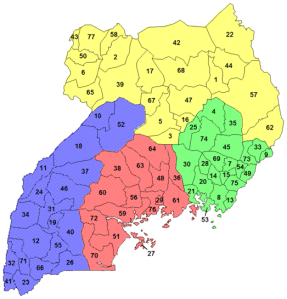
Uganda's Districts, 2010
In Patronage, District Creation and Reform in Uganda, Elliot Green argues that Ugandan Yoweri President Museveni has used the creation of new subnational district boundaries as a way of consolidating power through traditional patronage means. Looking at several African nations, Green notices that new boundary creation tends to increase as presidents’ margin of electoral victory diminishes. By creating new districts, he argues, regimes are able to offer better services to targeted segments of the population.
I think the main takeaway from this paper is that like the structural adjustment programs before them, autocrats have managed to manipulate decentralization efforts in an effort to maintain traditional vertical power relationships. It’s just sort of a given in development that decentralization is a good thing. The theory behind this is sound but there is lots of evidence that it doesn’t really work. To be fair, this isn’t the most egregious form of corruption; new boundaries don’t have the deleterious effect of useless ministries. Still, it’s worth keeping in mind the next time somebody you here somebody spouse the unchallenged benefits of decentralization.
Philippines bill would temper incumbency advantage
The PhilStar is reporting on a bill in the Philippines that would force candidates to resign from their current office to run for another one. The objective of the bill is said to prevent incumbents from using government resources to promote their candidacy.
His [Rep. Joseph Victor Ejercito] proposal was prompted by the congressional candidacy in the May 2010 elections of then President Gloria Macapagal-Arroyo, Ejercito said.
“Mrs. Arroyo, ignoring warnings that she would demean the presidency, ran for representative in Pampanga’s second district without turning over the seat of power to then Vice President Noli de Castro.”
Makes sense, although it reminds me of a California-style effort at electoral engineering -the kind that never works out. There have been a lot of good bills in the Filipino Congress that have died, so here’s hoping this one goes somewhere.
Egypt will not use automated voting system for next election

Egypt's Ministry of Communications and Information Technology, which is apparently in Smart Village, a PPP town on the outskirts of Cairo.
Al Ahram is now reporting that Egypt will not use an electronic voting system for the upcoming elections.
Egypt’s Minister of Communications and Information Technology Maged Othman announced in a press conference today that Egypt will not use electronic voting in the next presidential election.
Othman said electronic voting is currently too costly and requires extensive preparation to ensure the voting process is transparent and everyone is able to vote.
Othman also said Egypt will begin manufacturing the machines needed for electronic voting instead of importing them from overseas.
He added that currently the ministry is preparing the voting lists for the upcoming parliamentary and presidential elections. The minister also said that Egyptians will be able to vote using their national ID cards both in Egypt and overseas and that Egyptian embassies will oversee the voting process outside of Egypt.
This seems like pretty good news all around. The ability for expats to vote, in particular is more than feasible and there was no great reason not to do it. I previously expressed my doubts about an electronic election process, but that was mainly when I was unsure of whether internet voting was a potential. I think Egypt is more than capable of a well-done automated election, but it takes time – more than a few months – to choose a system, ensure it works, train poll workers how to use, etc.
I’ve stated before that the debate over the merits of election technology is largely unimportant. Technology is a tool, not an independent actor. In most cases it amplifies intent; both deficiencies and capabilities become more apparent. Whether Egypt ultimately decides to use automated machines or paper ballots is less important than how they decide to structure their Election Management Body, and how well they administer their elections.
Tunisian official proposes delaying elections to Oct 16
Not terribly surprising considering they haven’t worked out any details of the next election.
Egypt reveals new electoral law, stalls on system design

The New Wafd Party
Egypt’s military government announced amendments to the electoral law today, although noticeably absent was any mention of the country’s electoral system. From what I gather the debate is currently between list pr and single member districts although the details of either have been nonexistent.
While it’s nice they aren’t rushing such an important decision I do think they need hurry up if they want to hold the September elections on time. District creation takes time, at least if you want to do it fairly. Furthermore, this is creating an unfair burden on political parties who have no way of devising electoral strategies. If a nationwide, list pr system is adopted this is not nearly as big a deal, but that is unlikely. Any sort of district creation, however, will force parties to prioritize where they run candidates.
All electoral systems force tactical voting, but Egypt’s fractionlized party system will place an extraordinary burden on voters. In order to cast a tactical vote, a citizen must know the relative strength of each party. This allows an individual to avoid wasting a vote on a party that has no chance of winning, while picking the best option that has a realistic shot at victory. In Egypt, the electoral viability of any given party or candidate in a district will be largely unknown, and the longer it takes to draw district, the less time elites will have in providing that information to voters .
Formal models that predict the effective number of parties, optimal organization strategies for parties, and tactical voting decisions by electors, are all based on the assumption that actors have an understanding of the parties’ strength. I believe this lack of information will disproportionality hurt secular and liberal parties, while favoring the more organized Muslim Brotherhood. The reason for this? The Brotherhood occupies a space on the right of the political spectrum larger than any liberal party occupies on the left. Tactical voting, in other words, will be a much greater challenge for these voters. Or to use a Downsean model, the cost of obtaining information for a conservative is far less than that for liberals. It may be the case that Egypt’s military rulers are putting of the decision on an electoral system in an effort to make the election fair. The longer it takes for them to decide, however, the less legitimate the results will be.
Egypt to abandon current electoral system
It looks like Egypt will be scrapping its current electoral system in favor of some sort of mixed or parallel system. I’ll have more to say on this soon, but the short takeaway is this is terrific news for secular and liberal parties. Egypt’s current system creates several coordination problems and favors local elite powerbrokers over actual parties.


 Ahwa Talk