Category Archives: Middle East

Lebanon debating new electoral system

Lebanon’s been debating a new electoral system for some time now, but it seems these recent debates are actually a little more serious.  The talk is mostly about moving to some sort of PR system, which would be far more fair than what they have now.

Of course there is a reason that a fairer system hasn’t been implemented, and that’s because it would severely reduce the influence of a number of ethnic confessions.  It’s no shock, for example, that Druze leader Walid Jumblatt wants the current rules that have allowed him to be the “last man in” every coalition for his entire career.

Proportional representation was first proposed by my father the late Kamal Jumblatt when he was the head of the national front with the purpose of eliminating sectarianism . But since the ‘leftists’ are now politically weak… it is better to postpone the discussion about an electoral law [based on proportional representation], and maintain the status quo in order to preserve diversity,” National News Agency quoted him as saying.

It’s always great when you can just openly admit you don’t want a system because it will hurt you personally.

Egypt releases draft constitutional document

Excerpts in English can be found here.

Low voter registration numbers in Tunisa

From al-Ahram:

Just over 3.7 million of an estimated seven million potential voters had added their names to the roll, a member of the independent election commission, Larbi Chouikha, told AFP ahead of the close of registration at midnight (2300 GMT).

The provisional figure, which does not include an estimated 700,000 to 800,000 Tunisians of voting age abroad, represented about 52 percent of potential voters still in the country.

The commission will release official figures on Tuesday. Registration opened on July 11 and was supposed to close on August 2, but was prolonged due to a slow turnout.

The October 23 election will be for a constituent assembly charged with drawing up a new constitution to replace that of the former dictatorial regime.

This is a pretty amazing, especially when you consider how many Tunisians expressed an intent to vote in initial surveys.  Probably partly due to response bias in those polls, but also to the disorganized nature of the interim government in managing elections.

What’s the status of subnational government in Egypt?

I finally have a reason to post one of my photos from Alexandria

Via Heba Fahmy, comes this story regarding the appointment of Adel Labib as Governor of Qena.

CAIRO: Most residents of the Upper Egyptian city of Qena welcomed the decision to appoint Adel Labib as the governor for the second time, while others called for a new civilian governor…

Labib was previously the governor of Alexandria, where residents strongly opposed his decisions and hindered his development projects, according to Mahmoud.

…“Labib will try to prove that Alexandria’s residents were wrong about him,” Mahmoud said, adding that Qena’s residents will also try to prove that Mikhael was the wrong governor for them.

A governor isn’t liked in one area, so he’s simply moved to another.  Imagine Scott Walker getting dumped on Minnesota because they didn’t complain enough!

I’m not going to address the politics of the appointment, or the considerable controversy that recent appointments have caused in the past few months.  But I would like to know:  has there been any talk about changing the system of local governance in Egypt?  Governors are currently appointed by the president, which isn’t an unheard of system, but it’s not very accountable either. (Indonesia recently moved from central appointments to direct elections for its governors, although the execution hasn’t been flawless).

Egypt last held local elections in 2008 and the old rules had them staggered for four year terms.  Local elected officials didn’t have much power (shocking!) although the elections still had some  importance due to the potential impact they had on presidential elections.   (In order to qualify as an independent for the presidency, potential candidates had to collect 250 signatures from elected officials, who could be from both the local and national level).

Obviously a lot of important stuff needs to happen first, and local government elections aren’t considered that important when building a narrative about different factions vying  for control of the country.  When it comes to actually governing the country well, however, local government can be extremely important.  Hopefully the attention stakeholders are committing to the current electoral system will extend to subnational government as well.

Egyptian alliance demands changes to election laws

In Egypt, people still aren’t happy with the details of the new electoral law.  This is a pretty impressive list of players who are unified in opposition:

The alliance refused the law earlier and gave the SCAF and the government two weeks to modify it.

The SCAF law states that 50 percent of the seats will be elected through the individual system and 50 percents through closed party lists, while the Democratic Alliance law suggests the latter system be applied exclusively.

The Democratic Alliance, called for by Al-Wafd and the Muslim Brotherhood’s Freedom and Justice Party (FJP), comprises 28 parties from the left and far right, bringing together proclaimed liberals and Islamists.

It includes Al-Wafd, Nasserist, Al-Ghad, Al-Karama, Al-Tagammu, Labor, FJP, Al-Geel, Al-Ahrar and the Egyptian Arab Socialist parties, as well as the Salafi Al-Nour, Al-Fadila and Al-Tawheed Al-Araby parties….

The meeting was attended by presidential hopefuls Amr Moussa and Hisham Al-Bastawisy, Nasser Abdel Hamid, member of Revolution Coalition Youth, and deputy Prime Minister, Ali Al-Selmy.

What’s truly amazing is nobody knows how the districts will be drawn; that’s pretty essential knowledge for a party that wants to be competitive nationwide.  Of course every party will share this disadvantage, which probably means the major impact of the delay will be to weaken the already fragmented party system while strengthening the hands of local elites.

Egyptian SCAF unveils new electoral system

Egyptian Army council General Mamdouh Shahin announced on Wednesday final amendments to the country’s electoral law. The new system has a lot in common with what I previously wrote about, with some key changes. Under the new system, fifty percent of seats in the lower house of parliament, the People’s Assembly, will be awarded through closed-list proportional representation, while the other half will be awarded in two-seat districts.  This is a change from the draft law the SCAF put out where only one third of seats would be PR.  Perhaps the most interesting aspect is the extremely low threshold for entering parliament, which was placed at 1/2 of all national votes.

The new law also abolishes the 64 seats reserved for women, which was instituted before the last election in 2010. In its place is a provision that mandates every party list must include at least one female. Other changes in the law include lowering the age for candidate eligibility from 30 to 25, and stipulating that elections take place in three stages.

I can think of three major implications of the new laws.  Let’s start with the new PR tier.  The ordinal tier of seats will be divided into 58 constituencies, which for 252 seats (half of the 504 elected members) will create an average district magnitude of 4.3  That’s not very proportional; combined with the two seat districts this system still looks very majoritarian.   This makes the .5% threshold all the more bizarre.  As far as I know this would make Egypt’s threshold the lowest in the world, even more so than neighboring Israel.  While Israel’s one nationwide district allows for extreme party fragmentation, however, I don’t think Egypt’s threshold will have much impact.  Maybe Egypt’s planners read Carey and Hix’s recent paper, The Electoral Sweet Spot: Low-Magnitude Proportional Electoral Systems.  In the paper, the authors,  find an optimal district magnitude – around three to eight seats – which produces low party fragmentation while still retaining a level of proportionality associated with higher seats per district.  This sort of assumes, however, that the other half of seats aren’t awarded in the strange two-seat districts that Egypt’s will be.

The second, somewhat related point, is the impact this system will have on women’s representation.  Mandating one candidate per list be female is a weak stipulation.  With no requirement for where on the list the women has to be, it will be easy for a party to bury women at the bottom of their lists.  This incentive will only increase in small magnitude districts as it will become more likely that only the top one or two candidates will be elected.

As far as the three stages for elections go, I think this is also a bad idea.  The fear I have with this is it will give parties an incentive to call for a boycott after the first stage if they don’t like the results.  This could have the effect of delegitimizing an otherwise well-conducted election.  (I’m not assuming it will be of course).

The Implications of Egypt’s Proposed Electoral System (Long)

Wafd and Brotherhood form electoral alliance

From my friend Heba Fahmy, comes this story of the neo-liberal al-Wafd Party forming an alliance with the Muslim Brotherhood.  Naturally, this has drawn some heavy criticism.

The FEP, headed by business tycoon Naguib Sawiris, said it didn’t want to turn the upcoming People’s Assembly elections into “second class” elections, where political powers force their guardianship over the people through a unified list, instead of having free direct elections.

Al-Wafd and the MB have actually formed an alliance before, in the 1984 parliamentary elections.  At that time, Egypt used a Closed-list PR system with an extremely high threshold; a party or alliance needed eight percent of the national vote in order to enter parliament.   This caused all non-NDP parties to form strange alliances in an effort to simply meet that number and gain any seats at all.   At that time, Wafd was mostly free-riding off of the MB’s grassroots support and the Brotherhood was willing to tell its supporters to cast votes for a disproportionate amount of Wafd candidates.  Given that they were formally banned as a party, I guess they felt this was their best option.

Present day, however, the MB is running under their newly formed Justice and Freedom Party, and will have considerably more leverage in the relationship.   For the life of me, I can’t understand why Wafd would do this.  They are technically one of the most popular parties, but that’s only because support for parties is so low.  (The recent IRI survey placed Wafd in first place with just six percent of respondents claiming it’s their preferred organization) This certainly isn’t the action of a party that, as its leader Al-Sayed Al-Badawy claimed, are the most powerful in the country.   Wafd had already damaged its creditably with its willingness to serve as the NDP’s chosen opposition in the 2010 election.  I’m guessing this will not win them many more supporters.

President Assad’s Speech

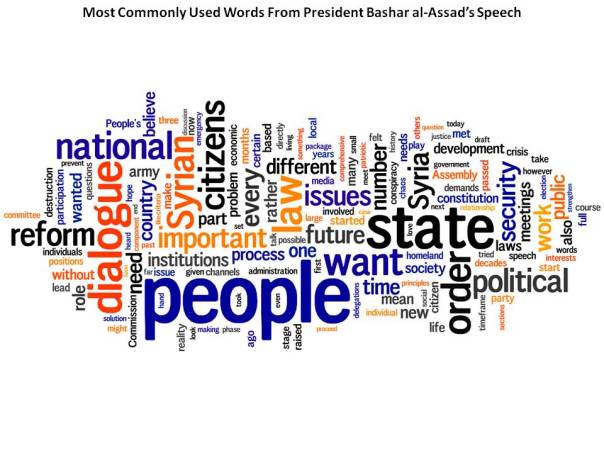
I’m a huge fan of innovative ways to visualize information but I have mixed feelings on Word Clouds, also known as Wordles. On a few occasions I’ve seen them put to good use, but most of the time they seem to be used to show something without really showing anything.   Given that President Assad recently became the latest Arab autocrat to give a long-winded, out of touch speech to his people that completely missed the point of why people might hate him, I thought it would be a good time to see if a Wordle could help us understand the main points of his message.  My efforts below:

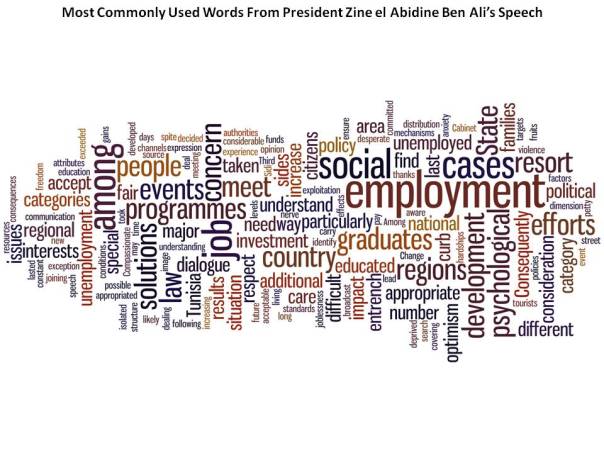
This all makes sense, and is in line with what I heard.  Dialogue, people, reform, and order all seem to be Assad’s main selling points.  To create a contrast, I made a word cloud for one of President Ben Ali’s speech, promising reforms in the face of mass protests.

Informative to a certain degree, but nothing Earth-shattering.  It does give you an easy way to identify the main points of each speech, although I don’t know if this method, while visually pleasant, is any more informative.

Egypt’s proposed electoral system

I’m about a week late to this but Egypt’s transitional military government has released a draft law of the country’s new electoral system.  The draft is somewhat short on details, such as minimum thresholds, but the basic thrust is that 1/3 of seats would be allocated through closed-list PR and the rest would use the individual candidacy system that is currently in place.  This means that each district has two candidates and each elector gets two votes.  If no candidate receives an absolute majority in the first round, a second round is held one week later.

Photo property of David Jandura

A rough translation of this from the draft law:

The individual candidate shall be elected by the absolute majority of valid votes cast in the election. If the two candidates who gained the absolute majority were not workers and peasants, the one with the largest number of votes shall be declared elected, and a re-election in the constituency shall be conducted between the candidates from workers and peasants who obtained the largest number of votes. In this case, the one with the largest number of votes shall be declared elected.

If there was no absolute majority for one of the candidates in the constituency, a re-election shall be conducted among the four candidates who obtained the largest number of votes, provided at least half of them are workers and peasants. In this case, the two candidates who got the highest number of votes shall be declared elected.

I will have more to say on this, but my main point is the individual tier, as it exists, is highly candidate-centric and will greatly weaken political parties.  In particular, the two-round, two-seat system creates an incentive for local elites to make grand bargains that further undermine an already weak party system.  Two elites, for example, can make a bargain where they tell their supporters to cast their two votes for each of them – a de facto joint ticket.   Those same elites could then make separate deals with weaker candidates.  This would entail a  promise to support the weaker candidate in the second round (should they make it) in exchange for first-round support for themselves.

The nascent party system in Egypt is very weak.  A recent IRI poll shows that of all existing parties, Al Wafd garners the most support with a paltry six percent.   Parties as institutions also suffer from worse approval ratings than state-owned media and the hated business community.  Creating even a small PR tier is a welcome move but I certainly hope the final law will make it much larger than 1/3 of all seats.