Blog Archives

India channels American Progressive Era

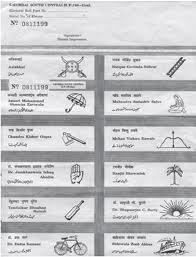
Indian ballot paper. Photo from Electoral System Design: The New International IDEA Handbook.

Via the Times of India, hunger-strike activist Anna Hazare, fresh of his victory advocating for anti-corruption measures, will now begin to push for electoral reform in India.  Hazare’s new idea is to introduce recall elections, which he hopes will provide another check on corrupt elected officials.

I’m generally not a fan of recall elections and it seems somewhat redundant to have them in a parliamentary system.  However, I believe the last two governments have lasted the full five-year terms, so maybe this isn’t such a bad idea.   I also wonder if India’s parliamentary system will make recalls more effective (versus those in presidential systems) as the less stable nature of parliamentary majorities will give parties  greater incentive to punish corrupt politicians.  This is because every recall election comes closer to directly threatening the jobs of every MP in the same alliance, as it would bring them closer to snap elections.  In contrast, a US member of Congress gets to keep their job till the next scheduled election, regardless of who’s in charge.

If you can get through the endless pop-up ads in the link, the article does have a nice summary of other electoral reforms that have support, but will probably go nowhere.

EC had proposed that in the ballot paper or on the ballot unit of the Electronic Voting Machine, there should be a column “none of the above” after the name of the last candidate. EC had said it would enable a voter to reject all candidates, if he chooses so. The proposal does not even require a big legislative intervention. All that is needed is an amendment to rules 22 and 49B of the Conduct of Election Rules, 1961.

…Bhushan was equally excited about building a system of referendum for important policy issues and legislations. “It is wrong to say people do not understand these issues. There could have been referendum for an issue like Indo-US nuclear deal. An elected representative is not representative for everything and does not understand all issues,” Bhushan said. He also said use of money power in elections was a big menace and needed to be made integral to electoral reforms.

Recalls and referendums. Direct democracy reminds me a lot of American Progressive demands during the turn of the last century.  While some of those reforms did bring more accountability (direct elections of senators), I’m not as convinced direct democracy has done the same.  Organized interests will find ways to influence the process, whether it be through an MP or direct plebiscite.

With that being said, it is inspiring to see India’ s success as a democracy and I hope they have the best of luck pushing for these reforms.

Jordan’s strange electoral system will be changed to something that is, hopefully, less strange

Jordan’s king (and fellow Hoya) Abdullah II, has thrown his support behind proposed changes to the country’s constitution the other day. The proposal is the latest change in a series of reforms that have yet to become law. In May, the government announced plans to do away with it’s current mess of an electoral system and move to one that uses some sort of party lists.  Most sources I’ve talked to say that the plan is indeed to move to party list PR, although the details haven’t been worked out yet.   Whatever the details are, however, it would be hard to not improve the system Jordan has now.

Jordan currently uses a variant of a Single non-Transferable Voting (SNTV) system, which is generally known as the worst electoral system out there.  Abandoned by Japan, and currently used in Afghanistan, SNTV has candidates running as individuals (not party lists)  in multi-member districts. Unlike Block voting, however, voters only get one vote.  So, for example, in a district with ten open seats, I get to vote for one person.  The top ten candidates with the most votes would then fill the seats.  One of the most salient effects of these rules is to weaken political parties (although it theoretically is fairly proportional).  This is because SNTV makes effective coordination nearly impossible, as parties would have to essentially run their own candidates against each other in every district.

SNTV is odd enough as it is, but Jordan decided to go a step further in the strange rules department when they instituted their new laws for the 2010 election.  The system remained SNTV (divided into 45 single- and multi-member constituencies) with the added confusion that these districts would be now further divided into virtual or “ghost districts.”   What is a ghost district you ask?  Well it’s simply a district that only the candidate can see…..Maybe that requires more explanation.

When registering for the election, candidates must declare which virutal district they want to run in.  So, for example, if there are ten open seats (all representing the exact same people mind you), a candidate must choose to run in seat… lets say 7.  That candidate will now be running only against every other candidate who chose the same district.  So now we have ten separate, First Past the Post, winner-take-all seats, all representing the same constituents.   The voter, however, still only gets to vote for one candidate.  This creates another coordination problem, as naturally, any candidate only wants to run in the easiest virtual district (the one with the least and weakest opponents).  Which district is the easiest, however, completely depends on the decisions of every other candidate, all of whom are also attempting to achieve the same outcome, and all also with the same lack of information necessary to do so.

If that isn’t clear, lets use the US as an example.  Lets say you live, like me, in northern Virginia.  Instead of being only able to vote in CD-8, you can choose to cast one vote for any candidate running for US House in the entire state.  They will all be representing you anyway. The candidates, though, still have to choose which Congressional district they want to run in. Sound like a good idea?

I never really figured out what the intentions for the virtual districts were, but my guess is it was a way for the King to throw coordination issues down to the local tribes, while keeping them happy by weakening political parties.  A system like this would have forced local elites to make pre-election bargains with one another so they could work out who ran in each district.

Whether I’m right or wrong, I’m pretty confident the virtual districts weren’t designed with the intention of making the country more democratic.  Hopefully the new reforms will create conditions more conducive to the forming of legitimate political parties that provide some sort of democratic accountability to the Jordanian people.
Lebanon debating new electoral system

Lebanon’s been debating a new electoral system for some time now, but it seems these recent debates are actually a little more serious.  The talk is mostly about moving to some sort of PR system, which would be far more fair than what they have now.

Of course there is a reason that a fairer system hasn’t been implemented, and that’s because it would severely reduce the influence of a number of ethnic confessions.  It’s no shock, for example, that Druze leader Walid Jumblatt wants the current rules that have allowed him to be the “last man in” every coalition for his entire career.

Proportional representation was first proposed by my father the late Kamal Jumblatt when he was the head of the national front with the purpose of eliminating sectarianism . But since the ‘leftists’ are now politically weak… it is better to postpone the discussion about an electoral law [based on proportional representation], and maintain the status quo in order to preserve diversity,” National News Agency quoted him as saying.

It’s always great when you can just openly admit you don’t want a system because it will hurt you personally.

Institutions still matter

I try not to stray too much in US politics on this blog, only because that information is so easily obtained elsewhere.  With that being said, party and electoral systems are well within the scope here so please read Hans Noel and Seth Masket’s new article in the Los Angeles Times.  The arguments shouldn’t be novel to readers of this blog but apparently it’s possible to be very successful while making the opposite points, so it’ s good to get this out there.

I think the key parts here aren’t the explanation for why we only have two major parties, but the defense against those who see parties as the problem.

All of this seems unfair. Why should these two parties have such an advantage? That’s the wrong way to look at it. The Democrats and the Republicans are not our overlords. They are us. They are the natural creations of politically concerned citizens who want to make a difference. And because in a democracy, the more people you have, the more chance you have of making a difference, parties organize together to have strength in numbers.

That is democracy: people joining together, compromising among themselves to arrive at policies, and trying to get those policies enacted.

If you’re not content with the way this country is being governed, one of the best ways to change it is to get involved with one of the existing parties and work to nominate and elect candidates at all levels of government who will fight for the things you care about. Odds are, one of the parties will want much of what you want. Pining for an independent, third-party dictator is not only a waste of your time, but if you somehow got what you wanted, you’d quickly find it wasn’t what you wanted at all.

Pretty much my thoughts. Organized people, elected by citizens, debating policy in deliberative bodies is a wonderful thing.    People who like democracy should not get so upset when they see it in action.

Egyptian alliance demands changes to election laws

In Egypt, people still aren’t happy with the details of the new electoral law.  This is a pretty impressive list of players who are unified in opposition:

The alliance refused the law earlier and gave the SCAF and the government two weeks to modify it.

The SCAF law states that 50 percent of the seats will be elected through the individual system and 50 percents through closed party lists, while the Democratic Alliance law suggests the latter system be applied exclusively.

The Democratic Alliance, called for by Al-Wafd and the Muslim Brotherhood’s Freedom and Justice Party (FJP), comprises 28 parties from the left and far right, bringing together proclaimed liberals and Islamists.

It includes Al-Wafd, Nasserist, Al-Ghad, Al-Karama, Al-Tagammu, Labor, FJP, Al-Geel, Al-Ahrar and the Egyptian Arab Socialist parties, as well as the Salafi Al-Nour, Al-Fadila and Al-Tawheed Al-Araby parties….

The meeting was attended by presidential hopefuls Amr Moussa and Hisham Al-Bastawisy, Nasser Abdel Hamid, member of Revolution Coalition Youth, and deputy Prime Minister, Ali Al-Selmy.

What’s truly amazing is nobody knows how the districts will be drawn; that’s pretty essential knowledge for a party that wants to be competitive nationwide.  Of course every party will share this disadvantage, which probably means the major impact of the delay will be to weaken the already fragmented party system while strengthening the hands of local elites.

Egyptian SCAF unveils new electoral system

Egyptian Army council General Mamdouh Shahin announced on Wednesday final amendments to the country’s electoral law. The new system has a lot in common with what I previously wrote about, with some key changes. Under the new system, fifty percent of seats in the lower house of parliament, the People’s Assembly, will be awarded through closed-list proportional representation, while the other half will be awarded in two-seat districts.  This is a change from the draft law the SCAF put out where only one third of seats would be PR.  Perhaps the most interesting aspect is the extremely low threshold for entering parliament, which was placed at 1/2 of all national votes.

The new law also abolishes the 64 seats reserved for women, which was instituted before the last election in 2010. In its place is a provision that mandates every party list must include at least one female. Other changes in the law include lowering the age for candidate eligibility from 30 to 25, and stipulating that elections take place in three stages.

I can think of three major implications of the new laws.  Let’s start with the new PR tier.  The ordinal tier of seats will be divided into 58 constituencies, which for 252 seats (half of the 504 elected members) will create an average district magnitude of 4.3  That’s not very proportional; combined with the two seat districts this system still looks very majoritarian.   This makes the .5% threshold all the more bizarre.  As far as I know this would make Egypt’s threshold the lowest in the world, even more so than neighboring Israel.  While Israel’s one nationwide district allows for extreme party fragmentation, however, I don’t think Egypt’s threshold will have much impact.  Maybe Egypt’s planners read Carey and Hix’s recent paper, The Electoral Sweet Spot: Low-Magnitude Proportional Electoral Systems.  In the paper, the authors,  find an optimal district magnitude – around three to eight seats – which produces low party fragmentation while still retaining a level of proportionality associated with higher seats per district.  This sort of assumes, however, that the other half of seats aren’t awarded in the strange two-seat districts that Egypt’s will be.

The second, somewhat related point, is the impact this system will have on women’s representation.  Mandating one candidate per list be female is a weak stipulation.  With no requirement for where on the list the women has to be, it will be easy for a party to bury women at the bottom of their lists.  This incentive will only increase in small magnitude districts as it will become more likely that only the top one or two candidates will be elected.

As far as the three stages for elections go, I think this is also a bad idea.  The fear I have with this is it will give parties an incentive to call for a boycott after the first stage if they don’t like the results.  This could have the effect of delegitimizing an otherwise well-conducted election.  (I’m not assuming it will be of course).

Fidesz introduces draft law for new electoral system

Fidesz - Hungarian Civic Union

Hungary’s governing party, the right-wing Fidesz,  proposed a plan this week to alter their country’s electoral system. Fidesz’s draft law would end the second round of voting in the National Assembly, cut the number of lawmakers from 386 to about 200, and abolish the system of compensation seats. Currently, Hungary has a unique system where compensatory seats are allocated to parties for non-winning candidates and party lists. The draft law would also allow Hungarians living abroad to vote, and guarantee ethnic minorities without representation a non-voting member in the National Assembly.

This is a pretty disturbing development although not shocking given the governing style of Fidesz since they’ve taken power.  Opposition parties argue that the proposed changes would benefit Fidesz, while hurting smaller parties, which is competely true. Unfortunately, there is not much anybody can do about it as Fidesz captured two-third of seats in the last election, which is enough to change the constitution unilaterally.  Two-thirds is a lot, but it hides the fact that the party only managed 53 percent of the popular vote.   Hungary’s system is parallel, not proportional, so its ordinal tier doesn’t really address any discrepancies that may arise from the nominal one.  Abolishing the second round for district-based seats, and removing the compensatory seats, however, is a big deal.   Everyone who looks at the 2010 election results agree that Fidesz would have performed even better if the proposed rules were in place.

I’m  a bit puzzled by the move to abolish the system of compensatory seats, which was useful for ensuring some ethnic minority representation.  I was always under the impression that Hungary was keen to provide minority representation because there were so many ethnic Hungarians living as minorities in neighboring countries.  I don’t know what the optimal way to ensure minority representation is but non-voting members doesn’t really seem to cut it. I know here in D.C., Eleanor Holmes Norton doesn’t feel she has much clout, and I imagine it is the same everywhere.  I would be curious to know though: are floor debates important in any legislative chamber any more?

The Implications of Egypt’s Proposed Electoral System (Long)

Ukraine moving forward with changes to electoral system

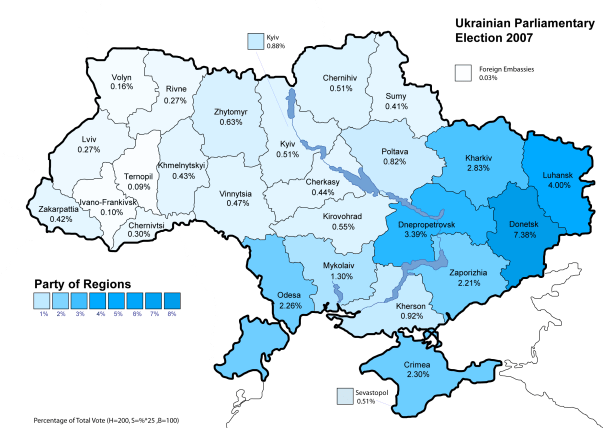
Party of Regions' performance in 2007. It's really only the Party of certain Regions (Photo property of DemocracyATwork).

Ukrainian President Viktor Yanukovych is forwarding the new draft law on elections to the Venice Commission, the next step in formally changing the country’s electoral system. Ukraine currently uses a closed list PR system, and the proposed reforms will add a tier of single member district seats. This will essentially revert Ukraine to a parallel system, which it had before the Orange Revolution in 2005.  Among the other proposed chanegs include:

  • Increasing the threshold from three percent to five;
  • Banning “Blocs,” defined as a group of politicians who share the same or nearly the same political goals;
  • Eliminating the option on ballots to “not endorse any candidate.”

The elimination of Blocs is a clear move to hurt Yulia Tymoshenko’s coalition (BYuT) although the official argument is that they produce unstable governments.  Reinstating the nominal tier is, likewise, considered an advantage for Yanukovych’s Party of Regions (PoR).  None of these are bad changes per se, but given the context, it has caused critics to cry fowl.   Yanukovych did manage to push through similar reforms at the local level last year so it is unlikely he will be unsuccessful this time around.

The importance of individuals in open list PR. Ctd.

Over at Fruits and Votes, MSS addresses my post on Hong Kong’s new method of filling vacant seats through OLPR.  He adds:

A potential benefit of the proposal, however, is that it should reduce the incentive of parties to rotate some of their legislators between elections. Doing so is common in OLPR systems–elsewhere (I do not know about Hong Kong)–and undermines the connection of elected legislators to the electorate. Under the Hong Kong proposal, a party would often forfeit the seat if it sought to swap out a member.

I was unaware of this phenomenon, but that makes sense.  I think this point really illustrates how unique this method is.  I typically associate PR parliamentary systems as being ones where the party owns the seat, not the individual.  As seat allocation is first determined by a party’s share of the vote, this is still somewhat true.  The new rule, however, would give an individual MP far greater ownership over their seat. MSS continues:

As for the Carey-Shugart (1995, Electoral Studies) we only claim that low-M OLPR places less premium on cultivating a personal reputation than does higher-M OLPR. The story is seen from the competing candidates’ point of view. From the voters’ point of view, however, smaller magnitudes and shorter lists undoubtedly increase the visibility of those who are elected, who win with greater shares of their party’s votes. I actually think this method for filling vacancies makes more sense for smaller district magnitudes than it would for larger. Whether it makes more sense than the usual party-centric way is an open question, and one that might not have a clear answer.