Via Yglesias come this paragraph in the Nation: Large debt–and the fear it creates–is a pacifying force. There was no tuition at the City University of New York when I attended one of its colleges in the 1970s, a time when tuition at many U.S. public universities was so affordable that it was easy to […]
Category Archives: Democracy
The other election in Africa this week
Most media attention has been focused on Liberia’s election this week, and with good reason. Also in Africa, however, Cameroon recently held presidential elections on Sunday. Opposition leaders demanded the election be nullified, after Paul Biya was reelected to a sixth term. Biya has ruled Cameroon for 29 years. In 2008, he passed a constitutional amendment, which abolished term limits.
Cameroon’s election wasn’t exactly fair, but what I found interesting was the assessment of what I would have thought to be a legitimate Election Observation Mission (EOM):
But France, which was Cameroon’s former colonial power and played a significant part in Biya’s rise to the helm in 1982, saw no egregious violation in the poll.
“According to the International Organisation of the Francophonie and the Commonwealth, who followed the development of these elections, we can consider that they took place in acceptable conditions,” Foreign Minister Alain Juppe said.
If you haven’t already, read Judith Kelley’s great paper, Election Observers and their Biases. It does a great job of exploring the behavior and incentives of EOMs based on a number of criteria. Her main argument is that the assessment of elections is influenced by the mission’s organization, the source of funding, and the host country.
She also discusses the problem that occurs when observers want to reward progress made in a country, but the environment does not warrant a positive assessment. It is in addressing this phenomenon that Kelley notices certain peculiarities in her data. The most striking is the fact that the more violent a pre-election environment is, the more likely observation missions will endorse an otherwise flawed poll. Kelley also touches upon some issues that have been addressed in previous writings, such as the phenomenon where pre-election irregularities are more likely to be ignored by an assessment team than those that occur during the polling process.
I really don’t know Cameroon, or France’s current interest in it, so I’m unsure of if any of these particular findings would explain this strange assessment. But this does fit Susan Hyde’s theory, which concludes that regimes have made the calculation that the presence of election observers has become a signal of democratizing, while the risks of a negative election observation report outweighs the benefits of not inviting any foreign observers. I would say that Paul Biya benefited from allowing an election observation mission, especially one from France.
Internet voting and turnout
Via Election Updates, comes this story out of Virginia,
Many county and state election officials often lament of low voter turnout, but Surry County, Va. is anticipating 100 percent voter turnout for an upcoming Republican Primary — or a zero percent turnout. A quirk in redistricting means that the county will have to open a polling place for one voter for the upcoming primary. It will cost the county approximately $2,000 to open the polling place for the day and even if the lone voter shows up in the early moments of election day, the county must keep the location open till polls officially close across the state. Registrar Lucille Epps said she contacted the Virginia Board of Elections to ask if the lone voter could be sent to the next closest precinct but was told that was not possible.
Paul Gronke astutely adds:
This is a fun and silly story that Mindy Moretti dug up, but there is a very good reason beyond cost that the voter should be sent to another precinct–privacy! Obviously, Registrar Epps can not report returns for this precinct, but notice that the Registrar CAN’T REPORT PRECINCT LEVEL RETURNS FOR THE OTHER PRECINCTS EITHER, because a simple calculation will reveal the single voter’s choices.

Norwegian Ministry of Local Government and Regional Development
This is a good point, and I wonder about it in a few other contexts. In Norway, for example, the country will be piloting an internet voting system for ten municipalities in their upcoming September local elections. If internet turnout matches that of Estonia’s first trial with i-voting, i-voters would be somewhere around 2 percent. Combine that with the low number of people per municipality, and the low number who vote in local elections, and it’s somewhat possible that you could have an extremely small number of internet voters per area. Maintaining transparency requires the government to post who voted via each method (paper ballot, early voting, internet) as well as the results for each method, so there could be a theoretical risk of being able to identify internet voters’ decisions. In most cases this isn’t that big of a risk, but it’s just a reminder of the many things that have to be considered when developing such a complex system.
What’s the status of subnational government in Egypt?

I finally have a reason to post one of my photos from Alexandria
Via Heba Fahmy, comes this story regarding the appointment of Adel Labib as Governor of Qena.
CAIRO: Most residents of the Upper Egyptian city of Qena welcomed the decision to appoint Adel Labib as the governor for the second time, while others called for a new civilian governor…
Labib was previously the governor of Alexandria, where residents strongly opposed his decisions and hindered his development projects, according to Mahmoud.
…“Labib will try to prove that Alexandria’s residents were wrong about him,” Mahmoud said, adding that Qena’s residents will also try to prove that Mikhael was the wrong governor for them.
A governor isn’t liked in one area, so he’s simply moved to another. Imagine Scott Walker getting dumped on Minnesota because they didn’t complain enough!
I’m not going to address the politics of the appointment, or the considerable controversy that recent appointments have caused in the past few months. But I would like to know: has there been any talk about changing the system of local governance in Egypt? Governors are currently appointed by the president, which isn’t an unheard of system, but it’s not very accountable either. (Indonesia recently moved from central appointments to direct elections for its governors, although the execution hasn’t been flawless).
Egypt last held local elections in 2008 and the old rules had them staggered for four year terms. Local elected officials didn’t have much power (shocking!) although the elections still had some importance due to the potential impact they had on presidential elections. (In order to qualify as an independent for the presidency, potential candidates had to collect 250 signatures from elected officials, who could be from both the local and national level).
Obviously a lot of important stuff needs to happen first, and local government elections aren’t considered that important when building a narrative about different factions vying for control of the country. When it comes to actually governing the country well, however, local government can be extremely important. Hopefully the attention stakeholders are committing to the current electoral system will extend to subnational government as well.
Thoughts on Oslo
I’m not a terrorism or Norway expert, so I’m not going to try to make any policy point about the horrible events that took place today. I will just say that during my recent trip, I was stunned by the noticeable amount of trust Norwegian society and institutions placed in one another. I actually didn’t realize I passed the parliament the first time I did on account of the fact that there were no visible security measures; you could simply walk right up to the walls. The same could be said about the royal palace, which was guarded only by a friendly military officer.
It wasn’t just protection of key buildings were I sensed a great deal of trust, however. Security at the airport was a remarkable contrast to the United States. I never went through customs and felt almost as if I walked off the airplane out of the airport. There was also no ticket booth on public transport; buying tickets was by and large done on the honor system. This contrast was really made evident coming back to the US, when I had to fill out my customary form declaring I didn’t touch any livestock or bring home any soil, only to wait in the long security line.
To be sure there are reasons for these differences. But regardless of whether more security is the correct policy response or not, I found the level of trust in Norway to be beautiful and it would be upsetting if that changed.
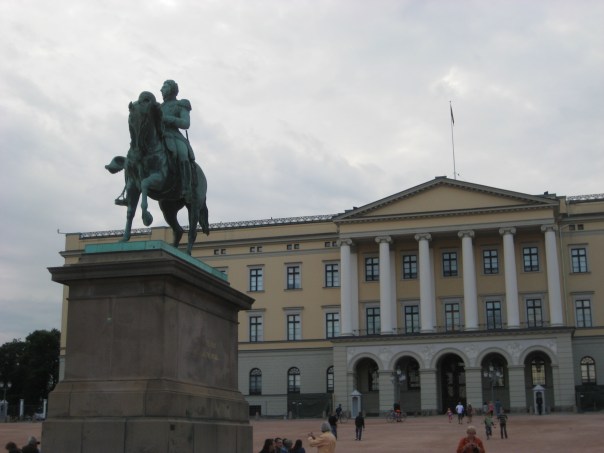
Royal Palace (Photo property of David Jandura)

The Norwegian Parliament (Storting) Photo property of David Jandura
The Virtues of Political Parties

I’m reading Nancy L. Rosenblum’s defense of political parties in her book, On the Side of the Angels. I already had a strong appreciation for parties, so it’s always nice to hear their virtues clearly articulated. While Rosenblum seems to be primarily writing to other political theorists, her message really needs to be told to citizens of struggling Central European countries, whose original expectations of democratic elections were unrealistic, or citizens in Sub-Saharan African counties like Zambia, Mozambique, or South Africa, where one party rule creates false accountability. I would guess, however, that nobody in those countries would have the attention span to make it through Rosemblum’s book, which while good, is much longer than I felt it needed to be. (She also has a tendency to litter scare quotes and quotations so often, it is nearly impossible to distinguish if she is quoting a fellow academic, or merely suggesting her own words are misleading.)
Some of Rosenblum’s themes, however, are important, and I wish she had shortened her book to focus on them. In particularly, her chapters where she writes about civil society and banning certain political parties have relevance for many transitioning and weak democracies. The tendency to view civil society as a substitute for parties, for example, is a common problem among democracy promoters working with less than democratic parliaments. Similarly, the debate over what should be a legal political party is timely given the events in the Middle East. I found Rosenblum dealt with these issues very well, offering a fair summary of the tradeoffs for banning parties based on different criteria. I tend to agree with her that any justification for banning a party runs into serious problems. The rule that a party can’t challenge the fundamental system of a government, for example, may sound like a good argument in the United States, but King Mohammed VI of Morroco could easily make the same statement while justifying the ban of a party that started demanding more power be invested in parliament.
The notion that there is a way to distinguish an acceptable party platform in a country assumes that there is a consensus on the fundamental structure of state institutions. Yet if there is a true consensus, then a party attempting to challenge it should garner few votes and pose little threat. Excluding them could only serve to push them out of the political arena and onto the streets. If the party does build substantial support, however, then there is clearly not a consensus on the legitimacy of the state. This does not mean that electoral engineering can never be a legitimate tool for state and nation building, but that it might not always be the best, or adequate, solution. In post-independence or post-conflict societies, political parties – some with violent pasts – may have to work together to build an uneasy consensus on the nature of the state. Here especially it is difficult to ban a party based on a platform.
False-residency election fraud
Mar 29
The study of election fraud is largely undeveloped in the academic community. Although there are some exceptions, such as Walter Mebane’s use of Bendford’s Law and random digit forensics, most research has been case-specific without broad implications. One type of election fraud, which often goes undiscussed, is when electors casting ballots in constituencies they don’t reside in. Kentaro Fukumoto and Yusaku […]
In which I sound like a Neocon
Mar 20
I think both Jon Chait and Matt Yglesias make characteristically strong arguments in debating the wisdom of getting involved in Libya. I’m glad I’m not a policymaker right now because I have very mixed emotions about this. On one hand, I share the worries, well expressed by Jeffrey Goldberg, about what happens after we become committed. And another […]
Elections in E-stonia
Mar 7
Estonia held parliamentary elections on Sunday, in which a record number of Estonians cast their ballots through the internet. This was Estonia’s fifth election where e-voting was an option and the second national-level poll to allow it. The almost 25 percent of voters who used the internet shows that there is an increasing level of […]


 Ahwa Talk