Author Archives: JD

Thoughts on Oslo

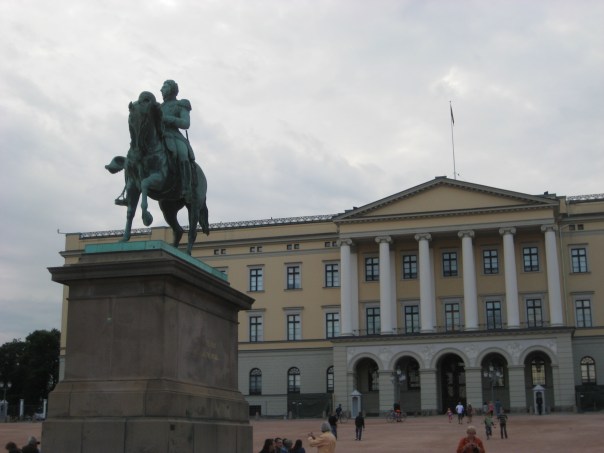
I’m not a terrorism or Norway expert, so I’m not going to try to make any policy point about the horrible events that took place today.  I will just say that during my recent trip, I was  stunned by the noticeable amount of trust Norwegian society and institutions placed in one another.   I actually didn’t realize I passed the parliament the first time I did on account of the fact that there were no visible security measures; you could simply walk right up to the walls.  The same could be said about the royal palace, which was guarded only by a friendly military officer.

It wasn’t just protection of key buildings were I sensed a great deal of trust, however.  Security at the airport was a remarkable contrast to the United States.  I never went through customs and felt almost as if I walked off the airplane out of the airport.  There was also no ticket booth on public transport; buying tickets was by and large done on the honor system.  This contrast was really made evident coming back to the US, when I had to fill out my customary form declaring I didn’t touch any livestock or bring home any soil, only to wait in the long security line.

To be sure there are reasons for these differences.  But regardless of whether more security is the correct policy response or not, I found the level of trust in Norway to be beautiful and it would be upsetting if that changed.

Royal Palace (Photo property of David Jandura)

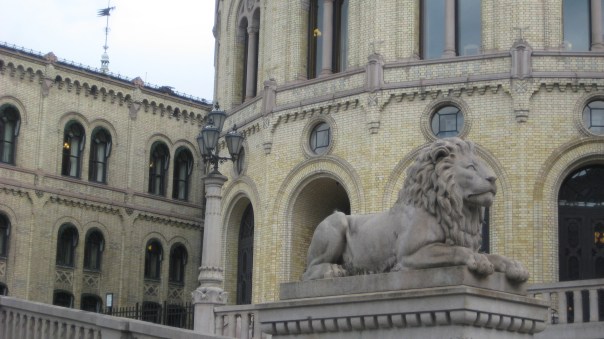
The Norwegian Parliament (Storting) Photo property of David Jandura

Fidesz introduces draft law for new electoral system

Fidesz - Hungarian Civic Union

Hungary’s governing party, the right-wing Fidesz,  proposed a plan this week to alter their country’s electoral system. Fidesz’s draft law would end the second round of voting in the National Assembly, cut the number of lawmakers from 386 to about 200, and abolish the system of compensation seats. Currently, Hungary has a unique system where compensatory seats are allocated to parties for non-winning candidates and party lists. The draft law would also allow Hungarians living abroad to vote, and guarantee ethnic minorities without representation a non-voting member in the National Assembly.

This is a pretty disturbing development although not shocking given the governing style of Fidesz since they’ve taken power.  Opposition parties argue that the proposed changes would benefit Fidesz, while hurting smaller parties, which is competely true. Unfortunately, there is not much anybody can do about it as Fidesz captured two-third of seats in the last election, which is enough to change the constitution unilaterally.  Two-thirds is a lot, but it hides the fact that the party only managed 53 percent of the popular vote.   Hungary’s system is parallel, not proportional, so its ordinal tier doesn’t really address any discrepancies that may arise from the nominal one.  Abolishing the second round for district-based seats, and removing the compensatory seats, however, is a big deal.   Everyone who looks at the 2010 election results agree that Fidesz would have performed even better if the proposed rules were in place.

I’m  a bit puzzled by the move to abolish the system of compensatory seats, which was useful for ensuring some ethnic minority representation.  I was always under the impression that Hungary was keen to provide minority representation because there were so many ethnic Hungarians living as minorities in neighboring countries.  I don’t know what the optimal way to ensure minority representation is but non-voting members doesn’t really seem to cut it. I know here in D.C., Eleanor Holmes Norton doesn’t feel she has much clout, and I imagine it is the same everywhere.  I would be curious to know though: are floor debates important in any legislative chamber any more?

Norway Blogging

Blogging has been light lately due to some travel.  I’m in Norway right now, where I came to meet with a team that will be evaluating the country’s internet voting project. In September, ten municipalities will be piloting an option where voters can cast ballots through the internet. (Twenty municipalities are also piloting allowing anyone over 16 years old to vote). There’s a lot to be said about internet voting and I won’t get into that now, but I will say that voting over the internet creates a number of challenges for maintaining such standards as a secret ballot and auditablity. With that being said, the Norwegian plan to accommodate these standards is very complex (too much so to explain here) but also well-thought out.

As far as random Norway facts go, I though I would share the following one about the Norwegian parliament. Seating arrangements in Parliament are made by constituency, not party affiliation like in most chambers. I’m guessing this was designed to promote inter-party cooperation but I doubt, given the little floor time of Norwegian MPs, it makes much difference.

Seat in Parliament (Photo property of David Jandura)

The Implications of Egypt’s Proposed Electoral System (Long)

Ukraine moving forward with changes to electoral system

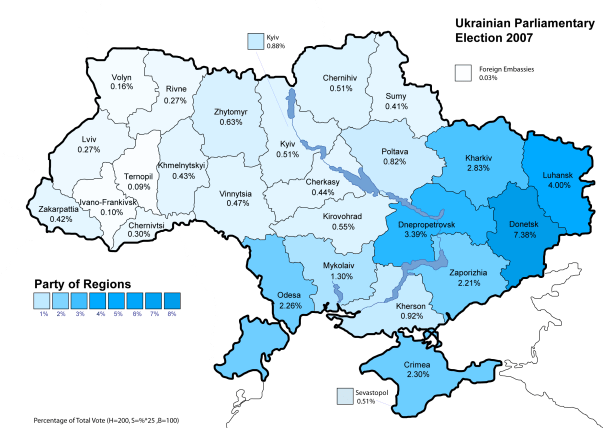
Party of Regions' performance in 2007. It's really only the Party of certain Regions (Photo property of DemocracyATwork).

Ukrainian President Viktor Yanukovych is forwarding the new draft law on elections to the Venice Commission, the next step in formally changing the country’s electoral system. Ukraine currently uses a closed list PR system, and the proposed reforms will add a tier of single member district seats. This will essentially revert Ukraine to a parallel system, which it had before the Orange Revolution in 2005.  Among the other proposed chanegs include:

  • Increasing the threshold from three percent to five;
  • Banning “Blocs,” defined as a group of politicians who share the same or nearly the same political goals;
  • Eliminating the option on ballots to “not endorse any candidate.”

The elimination of Blocs is a clear move to hurt Yulia Tymoshenko’s coalition (BYuT) although the official argument is that they produce unstable governments.  Reinstating the nominal tier is, likewise, considered an advantage for Yanukovych’s Party of Regions (PoR).  None of these are bad changes per se, but given the context, it has caused critics to cry fowl.   Yanukovych did manage to push through similar reforms at the local level last year so it is unlikely he will be unsuccessful this time around.

Wafd and Brotherhood form electoral alliance

From my friend Heba Fahmy, comes this story of the neo-liberal al-Wafd Party forming an alliance with the Muslim Brotherhood.  Naturally, this has drawn some heavy criticism.

The FEP, headed by business tycoon Naguib Sawiris, said it didn’t want to turn the upcoming People’s Assembly elections into “second class” elections, where political powers force their guardianship over the people through a unified list, instead of having free direct elections.

Al-Wafd and the MB have actually formed an alliance before, in the 1984 parliamentary elections.  At that time, Egypt used a Closed-list PR system with an extremely high threshold; a party or alliance needed eight percent of the national vote in order to enter parliament.   This caused all non-NDP parties to form strange alliances in an effort to simply meet that number and gain any seats at all.   At that time, Wafd was mostly free-riding off of the MB’s grassroots support and the Brotherhood was willing to tell its supporters to cast votes for a disproportionate amount of Wafd candidates.  Given that they were formally banned as a party, I guess they felt this was their best option.

Present day, however, the MB is running under their newly formed Justice and Freedom Party, and will have considerably more leverage in the relationship.   For the life of me, I can’t understand why Wafd would do this.  They are technically one of the most popular parties, but that’s only because support for parties is so low.  (The recent IRI survey placed Wafd in first place with just six percent of respondents claiming it’s their preferred organization) This certainly isn’t the action of a party that, as its leader Al-Sayed Al-Badawy claimed, are the most powerful in the country.   Wafd had already damaged its creditably with its willingness to serve as the NDP’s chosen opposition in the 2010 election.  I’m guessing this will not win them many more supporters.

President Assad’s Speech

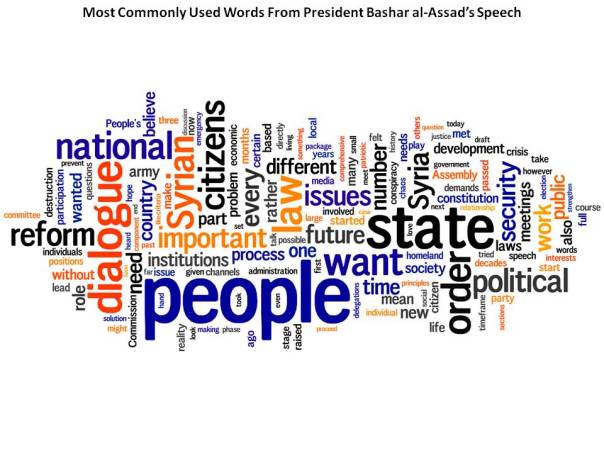
I’m a huge fan of innovative ways to visualize information but I have mixed feelings on Word Clouds, also known as Wordles. On a few occasions I’ve seen them put to good use, but most of the time they seem to be used to show something without really showing anything.   Given that President Assad recently became the latest Arab autocrat to give a long-winded, out of touch speech to his people that completely missed the point of why people might hate him, I thought it would be a good time to see if a Wordle could help us understand the main points of his message.  My efforts below:

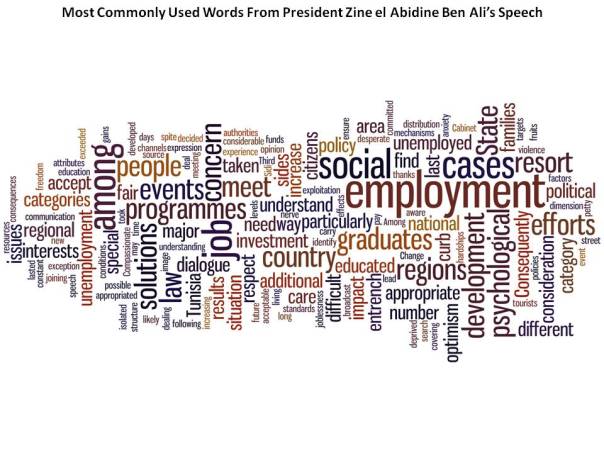
This all makes sense, and is in line with what I heard.  Dialogue, people, reform, and order all seem to be Assad’s main selling points.  To create a contrast, I made a word cloud for one of President Ben Ali’s speech, promising reforms in the face of mass protests.

Informative to a certain degree, but nothing Earth-shattering.  It does give you an easy way to identify the main points of each speech, although I don’t know if this method, while visually pleasant, is any more informative.

The Party Decides

Republicans held their first official debate last night, which I missed because I was watching the hockey game.   Just because I didn’t feel like watching, however, shouldn’t be interpreted as meaning I don’t think the debate was important.  In fact, I think it may be one of the most consequential debates of the year.

My professor, Hans Noel, is coauthor of a great book, The Party Decides, which contends that post McGovern-Fraser reforms, party elites still essentially control the nominating process.   According to the book’s model, modern parties should be viewed as a coalition of intense policy demanders with their own pet interests.  The role of the party leaders is to manage and placate each group so they stay in the coalition. This is somewhat similar to Seth Masket’s model, which states that Informal Party Organizations, or IPOs, determine the winners of primary elections, and thus, control party agendas.

I think this model of party structure is far more convincing than Aldrich’s model, laid out in Why Parties? (although otherwise a great book!) and certainly better than the very outdated bimodal model created by Anthony Downs so many years ago.  What’s especially great about the model, though, is we can actually test it during the current primary campaign! According to Hans and his coauthors, we are in the middle of the invisible primary, where the party, defined here as a wide assortment of elites, are making their decisions.  These elites will then signal primary and caucus voters on who to support.  That’s why these early debates are so important.  The Republican Party is made up of a many interested groups; all of whom are looking at how to best maximize their influence in the coalition.  Each elite then is evaluating candidates based on policy compatibly and electablity.  That’s why this early period is so important. While it’s difficult to quantify an inherently closed-door phenomenon, I think we should still be looking for elite signals in the next few months.  The average primary voter may not necessarily be watching these debates, but the party elites certainly are.  What they think may be all that matters.
The importance of individuals in open list PR. Ctd.

Over at Fruits and Votes, MSS addresses my post on Hong Kong’s new method of filling vacant seats through OLPR.  He adds:

A potential benefit of the proposal, however, is that it should reduce the incentive of parties to rotate some of their legislators between elections. Doing so is common in OLPR systems–elsewhere (I do not know about Hong Kong)–and undermines the connection of elected legislators to the electorate. Under the Hong Kong proposal, a party would often forfeit the seat if it sought to swap out a member.

I was unaware of this phenomenon, but that makes sense.  I think this point really illustrates how unique this method is.  I typically associate PR parliamentary systems as being ones where the party owns the seat, not the individual.  As seat allocation is first determined by a party’s share of the vote, this is still somewhat true.  The new rule, however, would give an individual MP far greater ownership over their seat. MSS continues:

As for the Carey-Shugart (1995, Electoral Studies) we only claim that low-M OLPR places less premium on cultivating a personal reputation than does higher-M OLPR. The story is seen from the competing candidates’ point of view. From the voters’ point of view, however, smaller magnitudes and shorter lists undoubtedly increase the visibility of those who are elected, who win with greater shares of their party’s votes. I actually think this method for filling vacancies makes more sense for smaller district magnitudes than it would for larger. Whether it makes more sense than the usual party-centric way is an open question, and one that might not have a clear answer.

The state of American democracy

Andrew Sullivan mulls over the collapse of American democracy:

EJ Dionne takes the Weiner “scandal” as the moment he realized we were late imperial Rome. PM Carpenter takes the Bush vs Gore Supreme Court ruling. Personally, I think it was some moment between the Congress’s assent to torture in 2006 and when Sarah Palin was selected as a serious vice-presidential nominee in 2008.

Any thoughts?

I know this is somewhat tongue-in-cheek, but it still strikes me as misplaced.  There is an understandable tendency to overestimate the importance of modern day events, and while I don’t disagree that these are important, I think we need to look at the big picture.  One theme I plan on addressing more in this blog is looking at American history, not as a country that was born as an shining city on a hill, but as a flawed, somewhat autocratic country that underwent a remarkable democratic transition.  I personally think a time to really worry about the state of our democracy would have been when the country split in two and fought a bloody civil war.  Maybe the armed insurgency that existed in the South for decades after would also be a cause for concern.   The successful coup d’etat, certainly didn’t bold well for our democracy, yet we are still here, a stronger democracy than ever before.

The bottom line is this is the first period in American history where the entire population is enfranchised and where political parties aren’t merely patronage machines that avoid adopting ideological policy positions.  Congress authorizing torture and a flawed presidential election may seem like the beginning of the end, until you stop to think about what the beginning was actually like.