Author Archives: JD
Egypt’s potential district boundaries
The new districts for Egypt’s parliamentary election were leaked the other day. You can find the links for the the nominal and list tier respectively, here and here. It appears that the districts will be based around Egypt’s 27 governorates, which makes some sense, but will also reduce proportionality. The allocation of PR districts is strange; district size is either four or six seats, regardless of governorate size. So Cairo, with 28 seats, is divided into seven districts of four seats. Not surprisingly, most parties are upset about the new boundaries, although the Muslim Brotherhood – to my knowledge – hasn’t really commented on them.
While there are limitations on what we can analyze (and I welcome comments from those more knowledgeable) we can examine many aspects of the new boundaries. The first, and perhaps most important, question to ask is if the boundaries are relativity fair, or malapportioned. This is easy to examine as population statistics are available. (One important note, for population I added the populations of Helwan to Cairo and 6th of October to Giza, as those two governorates were recently reintegrated into their old territories.)
Figure one shows that the population of a governorate and the number of PR seats it was awarded are largely related. The regression has an R squared score of .9178.
Figure one
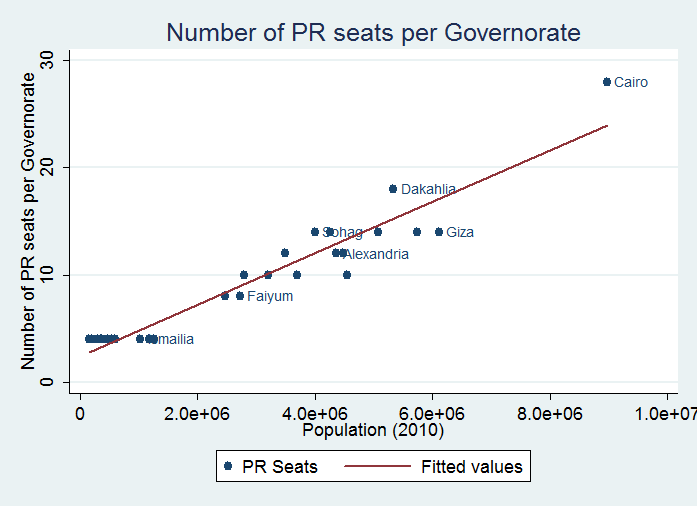
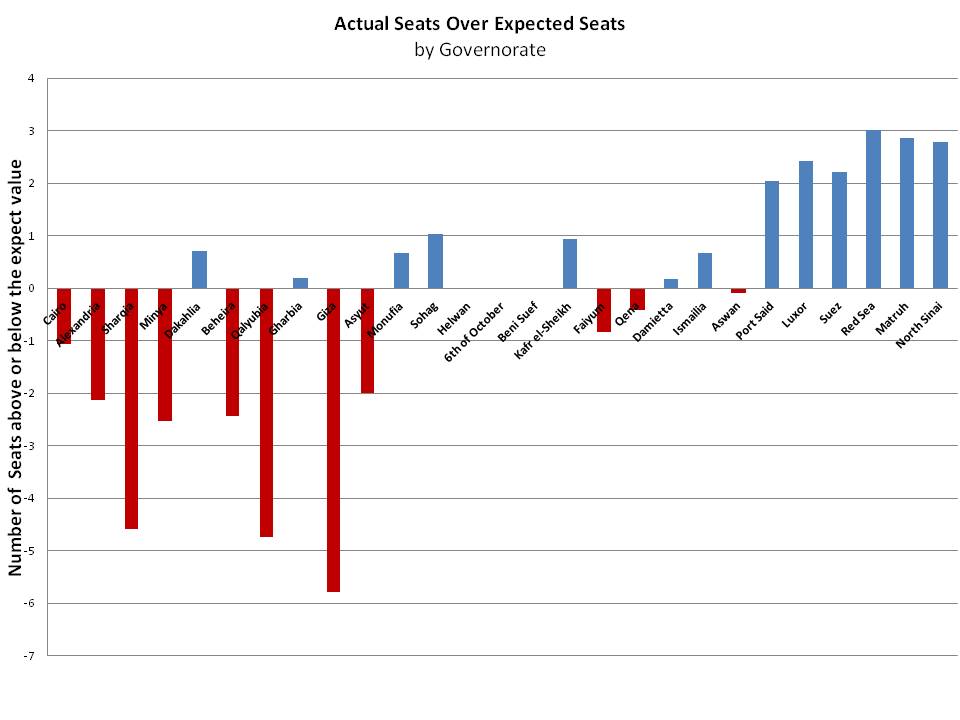
Figure two (click to enlarge) does a better job of showing which governorates received more or less seats than they would have if seats were perfectly distributed. Giza comes out pretty poorly, being underrepresented by almost six seats, followed by Qalyubia and Shariqia. At first glance this looks like a wide disparity, but in reality I think this isn’t too bad. The fact that the chart is compressed (so it was easier to read) gives the impression that there is a lot of range, but most governorates fall between one and two seats outside of their expected level. It is notable, however, that with few exceptions, higher population areas do worse than low ones. The governorates in the chart are ordered from highest population to lowest, so we can see a pretty obvious bias towards the right side.
Figure two
Next, we can look at how proportional each governorate is. I’m aware of some proportionality indices, but they only work if we have party votes. (If anybody knows a good way to measure without this information, please let me know). So absent this information, I tried another idea. I took the the percentage difference between district magnitude if the 252 PR seats were perfectly distributed, and the actual average district magnitude in each governorate. So, for example, if seats were distributed perfectly by population, Cairo would receive 29 seats. Then the most proportional distribution would be for all of it’s 8,968,694 residents to vote in one district with 29 seats. In reality, however, the average district magnitude is 4, with each one having 2,242,181 residents in it. Comparing the percentage difference of these numbers across governorates should allow us to view how proportional each region is in comparison to each other. Figure three shows there is once again a pattern; large population governorates are the least proportional while small ones are more so. Lines in red have an actual district magnitude lower than the expected value, while blue lines have a DM that is actually higher than we would expect. This pattern isn’t terribly surprising and should be expected when you hold the district magnitude constant across all regions, regardless of population.
Figure three
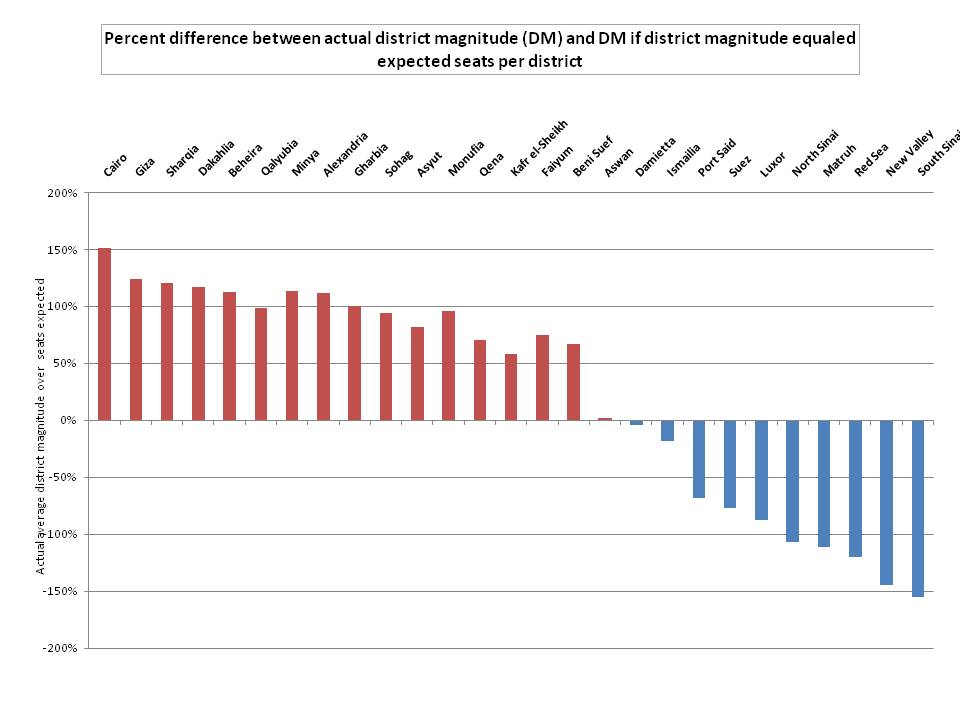
Cairo stands out as the least proportional governorate; its average DM of four means there are 1,933,549 more people per district than there would be if the governorate had a district magnitude of 29. (A 152% difference in actual district magnitude). Figure four shows the relationship between population and this measure of disproportionality.
Figure four
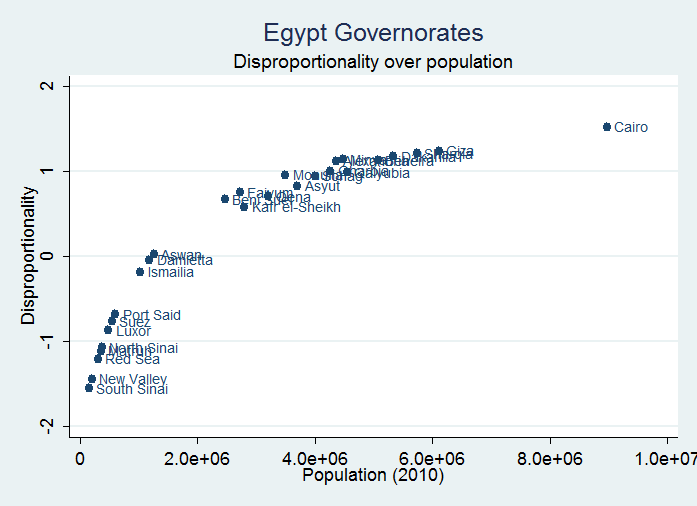
So the largest governorates enjoy a small, but real benefit as far as overall representation, but suffer with regards to proportionality. Overall, however, nothing seems too off with these boundaries.
So what are people saying about the boundaries? Well, mostly bad things. Some of the complaints, however, seem unfair:
Mohamed Farag, assistant secretary-general of Al-Tagammu Party, said that the distribution of constituencies was “illogical”.
“Giza governorate for example is divided into three constituencies … north, middle and south,” Farag explained, adding that the north combines villages with more developed districts.
“The needs and types of people in each area are different … and impossible to include in one constituency,” he added.
Heaven forbid an MP would have to represent more than one type of person. However, others are complaining that the large sizes of the territories will favor candidates with more money, as it costs more to run a campaign in larger areas. This probably has some merit with regards to the nominal tier of seats, but shouldn’t matter for the list tier. It is somewhat ironic, however, that this is a result of complaints by these same actors. The allocation of seats was originally planned with the nominal tier accounting for 2/3 of all seats. Parties, however, argued for the PR tier to count for more. They got their wish (the tiers are now split 50/50) but the decrease in nominal seats invariably means they will need to be larger.
Update: A recent discussion with an Egyptian friend of mine shed light on some of the complaints people are making with the district boundaries, especially those in the nominal tier. Districts, like they were in the past, are based around the presence of police stations. Yes, you read that correctly. Needles to say, this means that many districts aren’t exactly drawn in a manner most optimal to creating fair representation.
Update 2: Changes made in second graph after reading comments.
Electoral institutions and the cost of elections
To continue the topic in my recent DRC posts, Jay Ulfelder makes a great point about the difficulties poor countries face in holding fair elections.
I’m not suggesting that poor countries should forgo elections. The process is often expensive and messy, but it’s still preferable to the alternative of government by self-appointed rulers. Mostly, I hope the authors of electoral laws and procedures in poor countries will try to design systems that take these challenges into account. For example, why not hold presidential elections in one round instead of two, avoiding the costs and logistical problems of organizing runoffs?
… Not every country can afford every electoral system, and these financial and logistical difficulties ought to be a big part of the rule-making conversation in cases where they loom large.
Jay is bringing up an important, but often forgotten aspect in the study of electoral institutions. Despite not coming up frequently in academic literature, however, I will say that for the most part practitioners are very aware of election administration costs and system design. There are a few issues, however, that I think we should consider when discussing this.
- Institutions by nature are (and should be) hard to change. (Liberia just found this out the other week). If a country makes a decision to create a one-round system, there is a good chance it will believe a one-round system is always the only way it should ever do something, even if the logic behind that decision no longer holds true many years later. If we are choosing less optimal rules for the sake of cost, there may be long-term consequences down the road.
- Along the same point about the durability of electoral systems, most countries already have a legacy with a certain system. This could make the debate over changing the rules somewhat irrelevant. That being said, many of the poorest countries only hold elections due to donor pressure, which means the rules should be a little bit more malleable than normal.
- Political institutions are highly endogenous to political actors; the case in the DRC is a good example. There will always be winners and losers when rules are changed. Electoral systems should take into account the capacity of the country, but donors helping make such decisions should consider whether the political fallout from such changes would outweigh any benefits.
Why is decentralization still a silver bullet?
I realize there are plenty of development practitioners who are very aware of the limits of decentralization, but it’s still treated as somewhat of a silver bullet in the industry in general. The recent election administration problem in DRC – where decentralization is one of the key goals of donors – is a perfect demonstration of what is wrong with this line of thinking.
The central government in Kinshasa can’t afford to move election equipment to its country and we think that dividing the country to 26 new states will make things easier? How will each of those government administrations be able to procure election equipment for their local elections?
The short answer is, they couldn’t. Unfortunately, donors often view decentralization as an end in itself, rather than asking what greater goal it should serve.
Elections in DRC may (will) be delayed
Via Texas in Africa, this isn’t terribly surprising.
With just under three months to go until the polls are due to take place, Laurent Ndaye, a senior member of the country’s independent electoral commission (CENI), said equipment such as ballot boxes and voting booths were not yet in the country.
“We’ve proceeded to order the electoral hardware, we’ve paid for more than 70 percent. What’s posing the problem now is to transport all this material (to the Congo),” he said, adding that the kit was in China, South Africa, Germany and Lebanon.
The delays meant that materials will have to be flown in but the U.N. has refused to help so private firms would have to be contracted, raising the costs, he said.
In January, President Kabila’s allies in the legislature pushed through constitutional reforms that changed presidential elections from a two-round system, to a one-round, plurality vote. Kabila insisted it was a cost-saving measure, although critics (not without merit) accused Kabila of simply rigging the rules to benefit him. I think they were both right.
India channels American Progressive Era
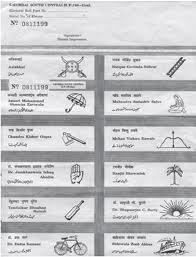
Indian ballot paper. Photo from Electoral System Design: The New International IDEA Handbook.
Via the Times of India, hunger-strike activist Anna Hazare, fresh of his victory advocating for anti-corruption measures, will now begin to push for electoral reform in India. Hazare’s new idea is to introduce recall elections, which he hopes will provide another check on corrupt elected officials.
I’m generally not a fan of recall elections and it seems somewhat redundant to have them in a parliamentary system. However, I believe the last two governments have lasted the full five-year terms, so maybe this isn’t such a bad idea. I also wonder if India’s parliamentary system will make recalls more effective (versus those in presidential systems) as the less stable nature of parliamentary majorities will give parties greater incentive to punish corrupt politicians. This is because every recall election comes closer to directly threatening the jobs of every MP in the same alliance, as it would bring them closer to snap elections. In contrast, a US member of Congress gets to keep their job till the next scheduled election, regardless of who’s in charge.
If you can get through the endless pop-up ads in the link, the article does have a nice summary of other electoral reforms that have support, but will probably go nowhere.
EC had proposed that in the ballot paper or on the ballot unit of the Electronic Voting Machine, there should be a column “none of the above” after the name of the last candidate. EC had said it would enable a voter to reject all candidates, if he chooses so. The proposal does not even require a big legislative intervention. All that is needed is an amendment to rules 22 and 49B of the Conduct of Election Rules, 1961.
…Bhushan was equally excited about building a system of referendum for important policy issues and legislations. “It is wrong to say people do not understand these issues. There could have been referendum for an issue like Indo-US nuclear deal. An elected representative is not representative for everything and does not understand all issues,” Bhushan said. He also said use of money power in elections was a big menace and needed to be made integral to electoral reforms.
Recalls and referendums. Direct democracy reminds me a lot of American Progressive demands during the turn of the last century. While some of those reforms did bring more accountability (direct elections of senators), I’m not as convinced direct democracy has done the same. Organized interests will find ways to influence the process, whether it be through an MP or direct plebiscite.
With that being said, it is inspiring to see India’ s success as a democracy and I hope they have the best of luck pushing for these reforms.
50,650,00 eligible voters in upcoming parliamentary elections
Refat Qomsan, Assistant Interior Minister for Administrative Affairs, stated during a seminar yesterday that around 50,650,000 citizens will be eligible to vote in the upcoming parliamentary elections. Qomsan also restated that every polling station will have no more than1,000 voters in an effort to keep polling station congestion at a minimum. My rough calculation of the number of registered voters form the March referendum was 44,995,034 voters, which is not an insignificant difference from the new number.
The voter registry is based off the national ID card, which everybody should have (and which have recently been updated with electronic chips) so the government shouldn’t have that hard a time getting the number right. I don’t really know of any stories of people being turned away from polling stations from the recent referendum, so the systems has seemed to work alright for now.
Diaa Rashwan, political analyst at the ACPSS, said that dividing voters according to their residential area is a major step, however, the Ministry of Interior also has to coordinate with the Ministry of Health in order to eliminate those who have passed away from the database, referring to the scheme used by the National Democratic Party in previous elections where they used dead citizens’ IDs to vote.
This is encouraging. Sharing lists of citizen data between an EMB and other parts of the government can have many administrative advantages. Often times, however, the agency in charge of the voter registry is underfunded compared to other ministries and has little clout. This makes it hard for them to get access to information that would be useful in constructing and maintaining an accurate and up-to-date voter roll. Seeing as Egypt’s new EMB is essentially controlled by the Interior Ministry, this probably won’t be an issue.
Jordan’s strange electoral system will be changed to something that is, hopefully, less strange
Jordan’s king (and fellow Hoya) Abdullah II, has thrown his support behind proposed changes to the country’s constitution the other day. The proposal is the latest change in a series of reforms that have yet to become law. In May, the government announced plans to do away with it’s current mess of an electoral system and move to one that uses some sort of party lists. Most sources I’ve talked to say that the plan is indeed to move to party list PR, although the details haven’t been worked out yet. Whatever the details are, however, it would be hard to not improve the system Jordan has now.
Jordan currently uses a variant of a Single non-Transferable Voting (SNTV) system, which is generally known as the worst electoral system out there. Abandoned by Japan, and currently used in Afghanistan, SNTV has candidates running as individuals (not party lists) in multi-member districts. Unlike Block voting, however, voters only get one vote. So, for example, in a district with ten open seats, I get to vote for one person. The top ten candidates with the most votes would then fill the seats. One of the most salient effects of these rules is to weaken political parties (although it theoretically is fairly proportional). This is because SNTV makes effective coordination nearly impossible, as parties would have to essentially run their own candidates against each other in every district.
SNTV is odd enough as it is, but Jordan decided to go a step further in the strange rules department when they instituted their new laws for the 2010 election. The system remained SNTV (divided into 45 single- and multi-member constituencies) with the added confusion that these districts would be now further divided into virtual or “ghost districts.” What is a ghost district you ask? Well it’s simply a district that only the candidate can see…..Maybe that requires more explanation.
When registering for the election, candidates must declare which virutal district they want to run in. So, for example, if there are ten open seats (all representing the exact same people mind you), a candidate must choose to run in seat… lets say 7. That candidate will now be running only against every other candidate who chose the same district. So now we have ten separate, First Past the Post, winner-take-all seats, all representing the same constituents. The voter, however, still only gets to vote for one candidate. This creates another coordination problem, as naturally, any candidate only wants to run in the easiest virtual district (the one with the least and weakest opponents). Which district is the easiest, however, completely depends on the decisions of every other candidate, all of whom are also attempting to achieve the same outcome, and all also with the same lack of information necessary to do so.
If that isn’t clear, lets use the US as an example. Lets say you live, like me, in northern Virginia. Instead of being only able to vote in CD-8, you can choose to cast one vote for any candidate running for US House in the entire state. They will all be representing you anyway. The candidates, though, still have to choose which Congressional district they want to run in. Sound like a good idea?
I never really figured out what the intentions for the virtual districts were, but my guess is it was a way for the King to throw coordination issues down to the local tribes, while keeping them happy by weakening political parties. A system like this would have forced local elites to make pre-election bargains with one another so they could work out who ran in each district.
Whether I’m right or wrong, I’m pretty confident the virtual districts weren’t designed with the intention of making the country more democratic. Hopefully the new reforms will create conditions more conducive to the forming of legitimate political parties that provide some sort of democratic accountability to the Jordanian people.
Lebanon debating new electoral system
Lebanon’s been debating a new electoral system for some time now, but it seems these recent debates are actually a little more serious. The talk is mostly about moving to some sort of PR system, which would be far more fair than what they have now.
Of course there is a reason that a fairer system hasn’t been implemented, and that’s because it would severely reduce the influence of a number of ethnic confessions. It’s no shock, for example, that Druze leader Walid Jumblatt wants the current rules that have allowed him to be the “last man in” every coalition for his entire career.
Proportional representation was first proposed by my father the late Kamal Jumblatt when he was the head of the national front with the purpose of eliminating sectarianism . But since the ‘leftists’ are now politically weak… it is better to postpone the discussion about an electoral law [based on proportional representation], and maintain the status quo in order to preserve diversity,” National News Agency quoted him as saying.
It’s always great when you can just openly admit you don’t want a system because it will hurt you personally.
Low voter registration numbers in Tunisa
Just over 3.7 million of an estimated seven million potential voters had added their names to the roll, a member of the independent election commission, Larbi Chouikha, told AFP ahead of the close of registration at midnight (2300 GMT).
The provisional figure, which does not include an estimated 700,000 to 800,000 Tunisians of voting age abroad, represented about 52 percent of potential voters still in the country.
The commission will release official figures on Tuesday. Registration opened on July 11 and was supposed to close on August 2, but was prolonged due to a slow turnout.
The October 23 election will be for a constituent assembly charged with drawing up a new constitution to replace that of the former dictatorial regime.
This is a pretty amazing, especially when you consider how many Tunisians expressed an intent to vote in initial surveys. Probably partly due to response bias in those polls, but also to the disorganized nature of the interim government in managing elections.


 Ahwa Talk